
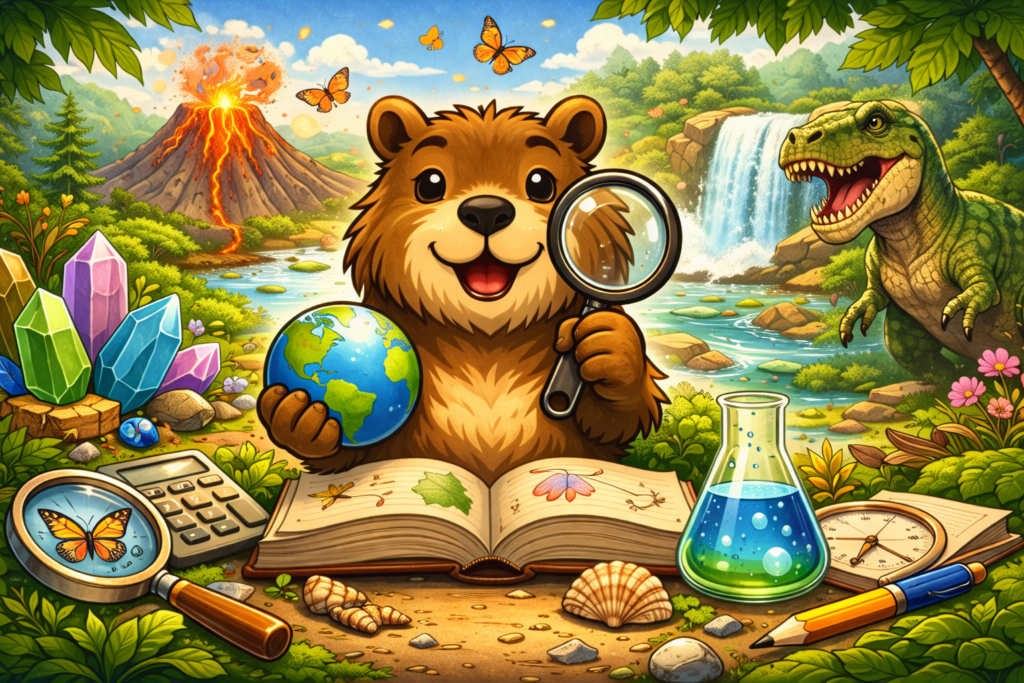
Learn with Liamming
The Learn section continues to grow as new articles are added. Each topic builds on the idea that curiosity begins with observation — whether watching ocean waves, exploring a forest, visiting a museum, or studying how animals move across the planet.
New articles will continue expanding areas such as ecosystems, wildlife behavior, Earth science, and the science behind everyday experiences.
Like the Liamming itself, learning moves forward calmly — one discovery at a time.
Welcome to the learning space of Liamming — a growing collection of thoughtful explorations designed for both children and adults who want to understand the world more deeply.
This is not a place for rushed facts or overwhelming information.
It is a place for steady discovery.
Why Learning Matters
Learning is often treated as something that belongs only in classrooms.
But learning is much larger than school.
It happens:
- When you stand beneath a towering dinosaur skeleton and wonder how it lived.
- When you look at a waterfall and ask how it formed.
- When you notice patterns in ocean waves.
- When you observe a turtle resting on the shore.
- When you think and imagine about things.
Curiosity is the beginning of knowledge.
The Liamming believes that curiosity should never disappear — not after childhood, not after graduation, not after years of routine.
Learning keeps the world interesting.
It reminds us that even familiar places hold stories beneath the surface.
Learning for Kids: Gentle Discovery
Children are naturally curious.
They ask questions constantly:
Why is the sky blue?
How do mountains form?
Where did dinosaurs go?
Why do turtles live so long?
The Learn section will offer simple, engaging explanations designed to:
- Encourage exploration
- Support classroom learning
- Inspire thoughtful questions
- Connect nature and science to real-world experiences
Learning for kids here will focus on clarity without overwhelm.
Complex topics can be explained in calm, understandable ways.
The goal is not to memorize facts.
The goal is to spark wonder.
Learning for Adults: Rediscovering Curiosity
Curiosity does not belong only to children.
Adults often forget that learning can be peaceful and enjoyable — not just productive.
The Learn section will also include content designed for adults who want to:
- Understand natural environments more deeply
- Learn the science behind landscapes
- Explore geology, ecology, and Earth systems
- Revisit topics from school with fresh perspective
Watching a waterfall becomes more meaningful when you understand erosion. Standing in a redwood forest becomes more powerful when you learn about growth cycles. Looking at Lake Tahoe becomes more fascinating when you understand water clarity and depth.
Knowledge enhances observation.
And observation enhances appreciation.
A Calm Approach to Education
Many educational platforms move quickly.
Information is often compressed into short bursts designed for speed.
Liamming takes a different approach.
Learning here will:
- Move at a steady pace
- Use clear language
- Focus on understanding rather than memorization
- Encourage thoughtful reflection
The world is already loud.
Learning does not need to be.
What You’ll Be Able to Explore
The Learn section will gradually grow into several key areas.
Each category will connect to real-world observations captured in Liamming’s videos and experiences.
🌎 Earth & Geography
Understanding landscapes helps us appreciate how the planet changes over time. Mountains rise through tectonic forces, rivers carve valleys through erosion, and coastlines shift as waves reshape the land.
Geography is not only about maps or locations. It is about the processes that shape Earth itself. When we look closely at waterfalls, deserts, forests, or islands, we begin to see how climate, geology, and water interact to create the environments we experience today.
Future topics in this section explore the natural forces that shape the planet and explain how different environments form and change across thousands or even millions of years.
Future topics may include:
- How waterfalls form
- Why lakes are different colors
- What makes coastal cliffs erode
- How volcanic islands are created
- Why deserts and forests exist in different regions
Geography is not just maps.
It is the story of how Earth shapes itself over time.
🦖 Science & Natural History
Science helps us understand the stories hidden within the natural world. Rocks, fossils, plants, animals, and ecosystems all reveal clues about how Earth has changed over millions of years.
Natural history explores those clues. By studying fossils, minerals, ancient environments, and living organisms, scientists can piece together how life evolved and how environments transformed over time. A fossil embedded in rock may reveal a creature that lived long before humans existed. A crystal growing within stone shows how minerals form under heat and pressure deep inside the Earth.
Observing nature closely often leads to scientific questions. Why do certain rocks form crystals? How did dinosaurs live and disappear? What roles do insects and small organisms play inside ecosystems? These questions help scientists understand how life interacts with the environment and how different systems on Earth remain connected.
Future topics in this section explore the science behind fossils, minerals, ecosystems, and the ancient history of life on our planet. By connecting observation with scientific explanation, natural history allows us to see the world not only as it appears today, but as it has evolved across vast stretches of time.
Future topics may explore:
- How fossils are formed
- Why dinosaurs went extinct
- How crystals grow
- What makes certain minerals colorful
- How ecosystems stay balanced
Science is not only laboratory work.
It is observation, pattern recognition, and asking thoughtful questions.
🧮 Math in the Real World
Math is often taught as symbols on paper, but in reality it describes patterns that exist everywhere in the world around us. When we look closely at nature, landscapes, and everyday objects, we begin to notice shapes, proportions, and repeating patterns that mathematics helps explain.
The angles of a mountain slope, the symmetry of a crystal, the rhythm of ocean waves, and the structure of buildings all rely on mathematical principles. Even something as simple as measuring distance on a map or estimating travel time involves mathematical thinking.
Understanding math in real environments can make it feel less abstract. Instead of focusing only on formulas, we can see how numbers help describe the structure and balance of the natural world. Geometry explains shapes in nature, ratios appear in waves and plant growth, and patterns emerge in everything from shells to snowflakes.
Future topics in this section explore how mathematics connects to the environments and experiences we encounter every day. By observing patterns in nature and technology, readers can discover that math is not only a school subject — it is a language that helps describe how the world works.
In future lessons, we may explore:
- Patterns in nature
- Symmetry in crystals
- Angles in mountain slopes
- Ratios in waves
- Geometry in architecture
Math describes the structure of the world.
When connected to real environments, it becomes more visible — and less intimidating.
🐢 Creatures & Wildlife
Animals are an essential part of Earth’s ecosystems. From insects in forests to whales crossing the oceans, every species plays a role in maintaining the balance of the environments where it lives.
Observing wildlife often raises fascinating questions. How do birds navigate thousands of miles during migration? Why do sea turtles return to the same beaches where they were born? How do animals adapt to survive in deserts, forests, oceans, and mountains?
Scientists study wildlife to understand how species interact with their habitats and with one another. These interactions form complex ecosystems where plants, animals, climate, and geography all influence how life develops and survives. Even small creatures like insects or plankton can have enormous impacts on the health of an ecosystem.
By observing animals carefully and learning about their behaviors, migration patterns, and survival strategies, we gain a deeper understanding of how life on Earth is connected. Wildlife reminds us that every species contributes to the larger systems that support life on our planet.
Future content may include:
- Habitat explanations
- Adaptation and survival strategies
- Migration patterns
- Ecosystem roles
Understanding creatures fosters respect.
And respect encourages conservation.
🌊 Oceans & Water
Water connects nearly every environment on Earth. Oceans cover most of the planet’s surface, shaping weather patterns, supporting countless forms of life, and influencing the landscapes we see along coastlines and rivers.
The movement of water creates many natural processes. Ocean currents transport heat around the planet, waves reshape beaches and cliffs, and the water cycle moves moisture through clouds, rain, rivers, and lakes. These systems work together to regulate climate and support ecosystems both on land and beneath the sea.
Beneath the surface of the ocean exists an extraordinary variety of life. From microscopic plankton to enormous whales, marine ecosystems contain some of the most diverse habitats on Earth. Coral reefs, kelp forests, deep-sea environments, and coastal wetlands all support unique communities of organisms that depend on healthy ocean systems.
Future topics in this section explore how water moves through Earth’s environments and how marine ecosystems function. By understanding oceans, rivers, and the water cycle, we gain insight into one of the most important systems that sustains life on our planet.
Future explorations may include:
- The water cycle
- Ocean currents
- Why waves form
- Freshwater vs. saltwater ecosystems
- The importance of wetlands
Water shapes land and sustains life.
Learning about it deepens appreciation.
🚂 Inventions & Transportation
Human curiosity has always driven innovation. Throughout history, people have developed tools and machines that help them move farther, explore new places, and connect distant communities.
Transportation inventions changed the world in powerful ways. Early roads and sailing ships allowed trade and travel across long distances. Later innovations such as steam engines, railways, automobiles, and airplanes made it possible for people and goods to move faster than ever before.
These technologies shaped cities, economies, and cultures. Railroads connected growing towns, highways expanded travel across continents, and air travel brought distant countries within reach. Each invention reflects both engineering creativity and the human desire to explore.
Understanding transportation also reveals how science and engineering work together. Concepts such as motion, energy, friction, and mechanical design influence how vehicles move safely and efficiently. Observing trains, vehicles, or aircraft in action can help us understand how these principles operate in the real world.
Future topics in this section explore how transportation technologies developed and how engineering continues to shape the way people move across the planet.
Transportation is more than movement.
It shapes:
- Cities
- Economies
- Trade
- Communication
- Culture
Before modern transport, travel was slow and difficult. Goods moved at the speed of walking animals or wind-powered ships.
When machines began moving people and cargo faster, the world changed.
Railways connected cities.
Cars reshaped towns.
Airplanes connected continents.
Transportation compresses distance.
Connecting Learning to Experience
The Liamming’s travels are not separate from learning.
They are connected.
A museum visit becomes a science lesson.
A coastal drive becomes a geography lesson.
A waterfall becomes a physics lesson.
A turtle sighting becomes a biology lesson.
Education is strongest when it connects to something real.
The Learn section will build on the places already explored and expand outward.
For Families
This space is designed to be welcoming for families.
Parents can explore topics alongside children.
Students can revisit subjects in calmer language.
Adults can rediscover topics they once rushed through.
Learning together builds shared understanding.
Curiosity grows when it is encouraged.
Liamming is designed as a welcoming space where families can explore a wide variety of topics together in a calm and engaging way. Rather than overwhelming visitors with noise or rapid content, the site invites curiosity at a steady pace. Families can move from immersive travel walkthroughs — quiet coastlines, museums, forests, waterfalls — to thoughtfully written learning pages that explain the science, history, and natural systems behind what they see. This connection between observation and understanding turns simple viewing into shared discovery.
One unique aspect of Liamming is that it blends exploration and education without separating them into rigid categories. A video of a shoreline can naturally lead to learning about ocean currents. A walk through a redwood forest can connect to geology, ecology, and climate. A museum visit can spark curiosity about fossils, minerals, or dinosaurs. Because topics are organized clearly by subject, families can follow their interests easily, building knowledge step by step. Children can ask questions, teens can dive deeper into concepts, and adults can rediscover familiar subjects with fresh perspective.
Liamming also encourages conversation. Without heavy narration or constant commentary, videos create space for families to pause, notice details, and talk about what they observe. The learning pages extend those moments into thoughtful explanations written in accessible language for multiple age levels. In a fast-moving digital world, Liamming offers something different — a shared environment where curiosity grows in stillness, exploration feels intentional, and learning becomes a meaningful family experience rather than a rushed task.
A Growing Library
The Learn section is just beginning.
Over time, it will grow into a structured library of topics organized clearly by subject and level.
Future pages may include:
- Beginner-friendly introductions
- Deeper dives for older learners
- Visual diagrams
- Real-world examples
- Links to related walkthrough videos
Each new addition will follow the same principle:
Move forward. Stay kind. Observe deeply.
The Spirit of the Liamming
The Liamming does not rush into knowledge.
It sits beside a river and wonders how it flows.
It watches clouds and asks how they form.
It notices patterns in leaves and wonders why they repeat.
Curiosity does not require noise.
It requires attention.
Learning is not about collecting information quickly.
It is about understanding slowly.
The Liamming reminds us that it is okay to pause with a question — to hold it gently rather than demand an immediate answer.
An Invitation to Explore
Whether you are:
- A child discovering science for the first time
- A parent guiding curiosity
- An adult rediscovering forgotten subjects
- Or simply someone who enjoys understanding the world more deeply
You are welcome here.
The Learn section will continue to expand thoughtfully — adding new areas of exploration while maintaining the calm spirit that defines Liamming.
The world is wide.
There is always something to learn.
And like the Liamming, we can move forward steadily — curious, patient, and ready to discover what lies just beyond the next horizon.
Let’s find out what type of Explorer you are
Quiz Disclaimer: The Liamming Explorer Type Quiz is provided for educational and entertainment purposes only. It is not a psychological assessment, diagnostic tool, or medical evaluation. The results are not intended to diagnose, treat, prevent, or prescribe for any mental health, developmental, behavioral, or learning condition.
The quiz does not replace professional advice from licensed psychologists, physicians, educators, or other qualified professionals. If you have concerns about yourself or a child’s development, mental health, or learning needs, please consult a licensed professional for proper evaluation and guidance.
By participating in this quiz, you acknowledge that the results are general, informational, and intended solely for personal reflection and enjoyment.
“Learn to get in touch with the silence within yourself, and know
that everything in life has purpose. There are no mistakes, no
coincidences, all events are blessings given to us to learn from.” – E. Kubler-Ross
Understanding the World Through Observation
The articles on Liamming are inspired by a simple idea: the world becomes more interesting when we slow down and look closely.
Many topics explored here begin with real observations — walking through forests, visiting museums, standing beside waterfalls, watching animals in their habitats, or exploring coastlines and landscapes. These experiences often raise questions about how natural systems work, how environments form, and how living creatures adapt to the world around them.
From those observations, each article connects everyday experiences to scientific ideas. Topics may include ecology, geology, ocean science, natural history, or human learning and development. The goal is not to overwhelm readers with technical language, but to explain complex ideas in a clear and thoughtful way that encourages curiosity.
Liamming’s approach to learning is based on patience and reflection. Instead of rushing through information, the articles encourage readers to explore topics slowly, ask questions, and notice patterns in nature and human behavior.
Learning is not only something that happens in classrooms. It can happen while observing a sunset, walking beside a lake, visiting a museum exhibit, or watching wildlife in its natural environment. By connecting real experiences to scientific ideas, these articles aim to help readers understand the world more deeply and appreciate the systems that shape it.
As the Liamming continues exploring new places and ideas, this collection of articles will continue to grow — offering new opportunities to learn about nature, science, and the ways curiosity helps us understand the world.
Sources & Learning Resources
Articles on Liamming are written to encourage curiosity and exploration.
Readers interested in deeper study may explore resources from organizations such as: