
What Minerals Are, How They’re Classified, and Why They Matter
The Liamming once stood in a quiet museum hall, observing crystals glowing under soft light. Some were clear, others deep purple, and some shimmered like glass. Each one seemed simple at first glance — yet each held a story shaped by time, pressure, and the forces within the Earth.
Moments like this often lead to a simple question: what are minerals, really?
Minerals may appear as decorative objects in a display case, but they are far more than beautiful stones. They are naturally occurring substances that form the building blocks of rocks, landscapes, and even the ground beneath our feet. From mountains and canyons to sand and soil, minerals shape the physical structure of the planet.
Scientists study minerals to understand how the Earth forms and changes over time. By examining their composition, structure, and properties, minerals can be classified into groups that reveal how they were created and how they interact with the environment. This knowledge connects geology, chemistry, and Earth science into a deeper understanding of the world around us.
Minerals also play an essential role in everyday life. They are used in construction, technology, energy production, and countless materials we rely on daily. What may seem like a small crystal in a collection is often part of a much larger system that supports modern society.
In this guide, we will explore what minerals are, how they are classified, why they matter, and how collecting and observing them can inspire curiosity about the Earth itself.

What Is a Mineral?
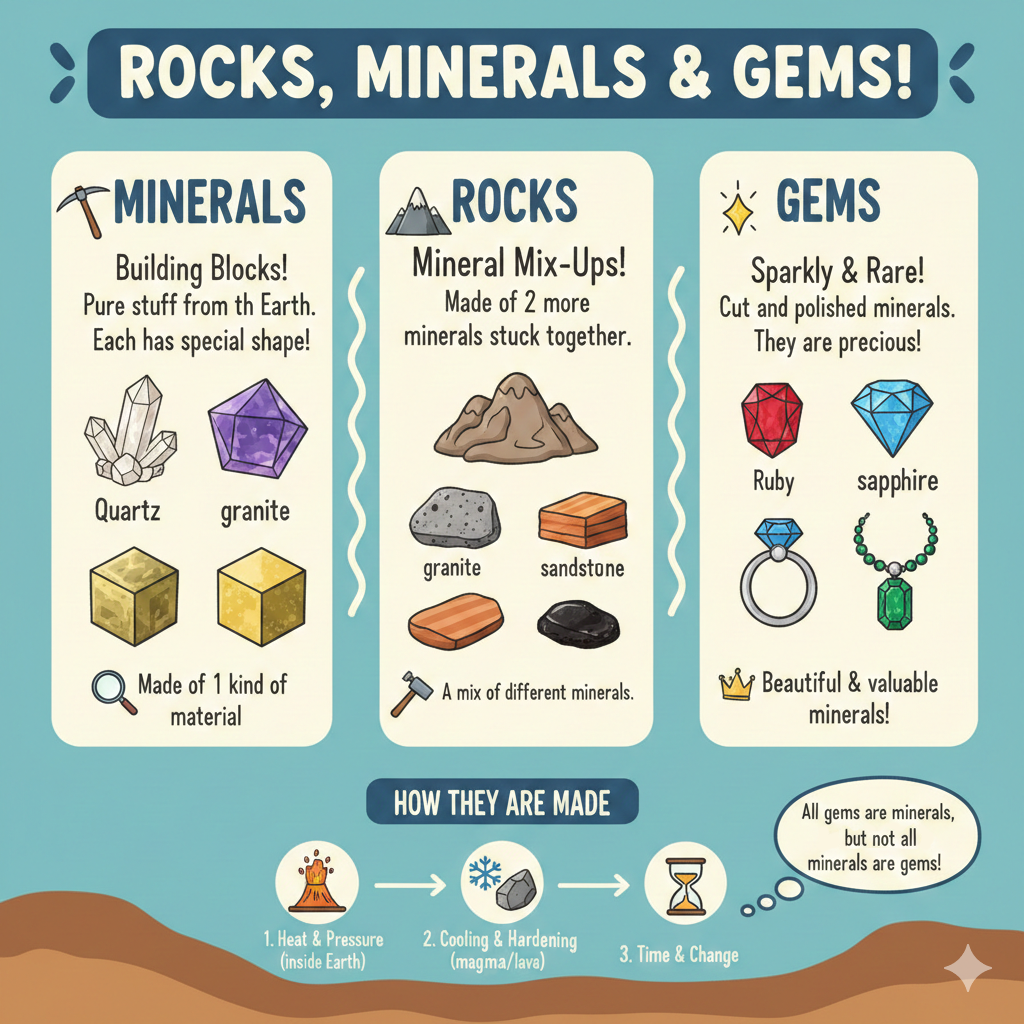
A mineral is a naturally occurring solid substance with:
- A specific chemical composition
- A crystalline structure
- A consistent internal arrangement of atoms
To be considered a mineral, something must form naturally in Earth’s crust. That means materials made in a lab are not technically minerals, even if they look similar.
For example:
- Quartz is a mineral.
- Gold is a mineral.
- Diamond is a mineral.
- Granite is not a mineral — it is a rock made of several minerals.
Minerals vs. Rocks
This is one of the most common questions.
A mineral is a single substance.
A rock is made of one or more minerals combined together.
For example:
Granite contains:
- Quartz
- Feldspar
- Mica
Each of those is a mineral. Together, they form a rock.
Understanding this difference helps us see how Earth is built — layer by layer.
How Minerals Form
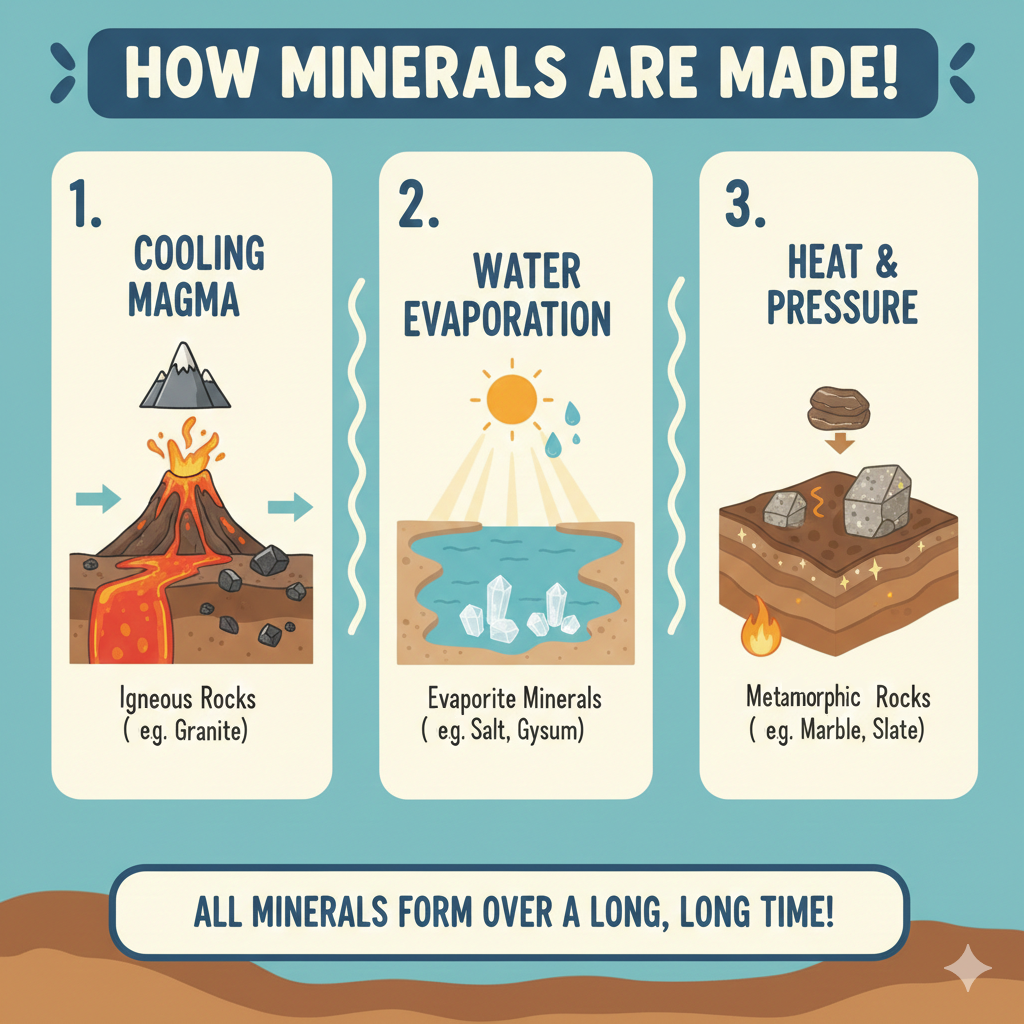
Minerals form in several ways.
1. From Cooling Magma
When molten rock (magma) cools underground or lava cools above ground, crystals begin to form.
Slower cooling often creates larger crystals. Faster cooling produces smaller ones.
2. From Water Evaporation
When mineral-rich water evaporates, solid crystals can remain behind.
For example:
- Salt deposits form when seawater evaporates.
3. From Heat and Pressure
Deep underground, intense heat and pressure can change minerals into new forms.
This process creates metamorphic minerals.
How Minerals Are Classified
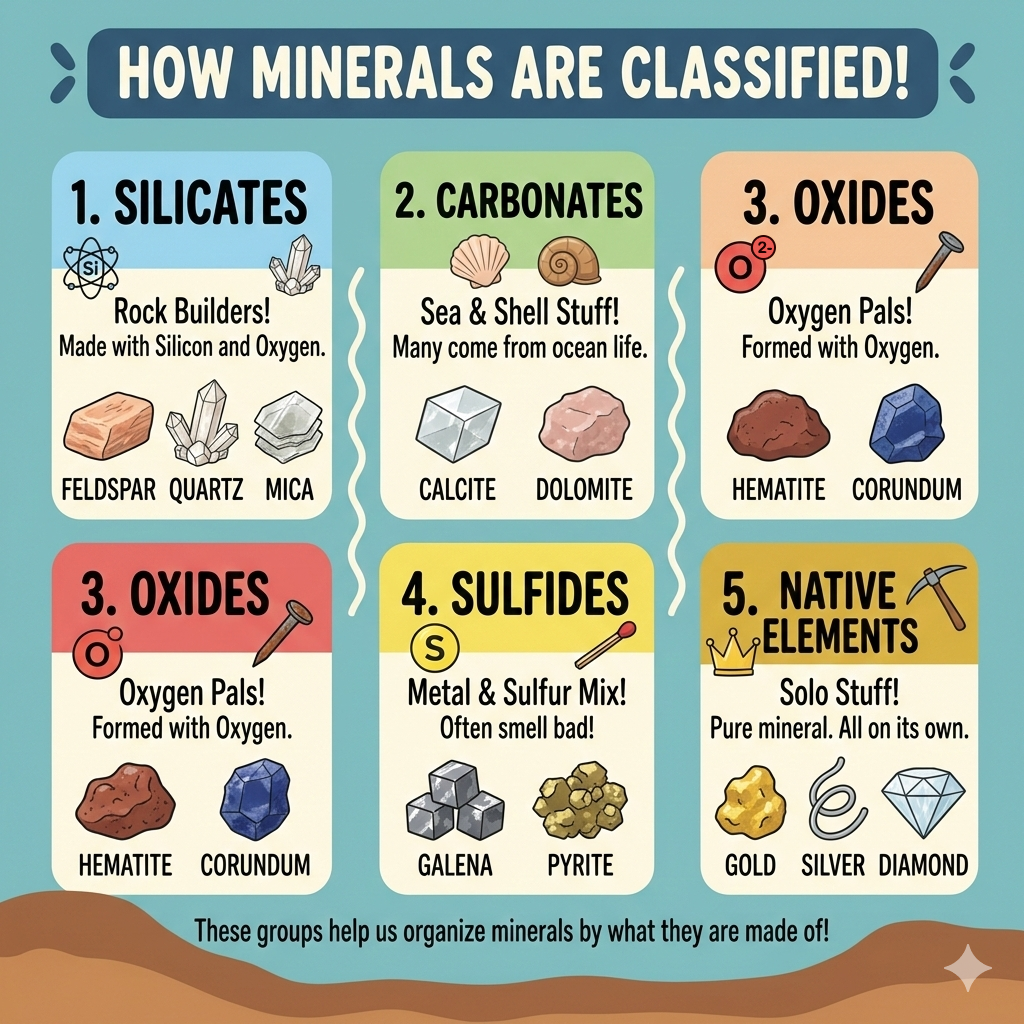
Scientists classify minerals based on their chemical composition and internal structure.
There are thousands of known minerals, but most fall into several major groups.
1. Silicates
Silicates are the most common group.
They contain silicon and oxygen.
Examples:
- Quartz
- Feldspar
- Mica
Much of Earth’s crust is made of silicate minerals.
2. Carbonates
These minerals contain carbon and oxygen.
Example:
- Calcite (found in limestone)
Carbonates are important in both geology and biological systems.
3. Oxides
Oxides contain oxygen and one or more metals.
Example:
- Hematite (an iron ore)
These are important sources of metals.
4. Sulfides
Sulfides contain sulfur combined with metals.
Example:
- Pyrite (often called “fool’s gold”)
5. Native Elements
These are minerals made of a single element.
Examples:
- Gold
- Silver
- Copper
- Diamond (carbon)
Classification helps scientists understand:
- How minerals formed
- Where they are likely to be found
- What they can be used for
Physical Properties of Minerals
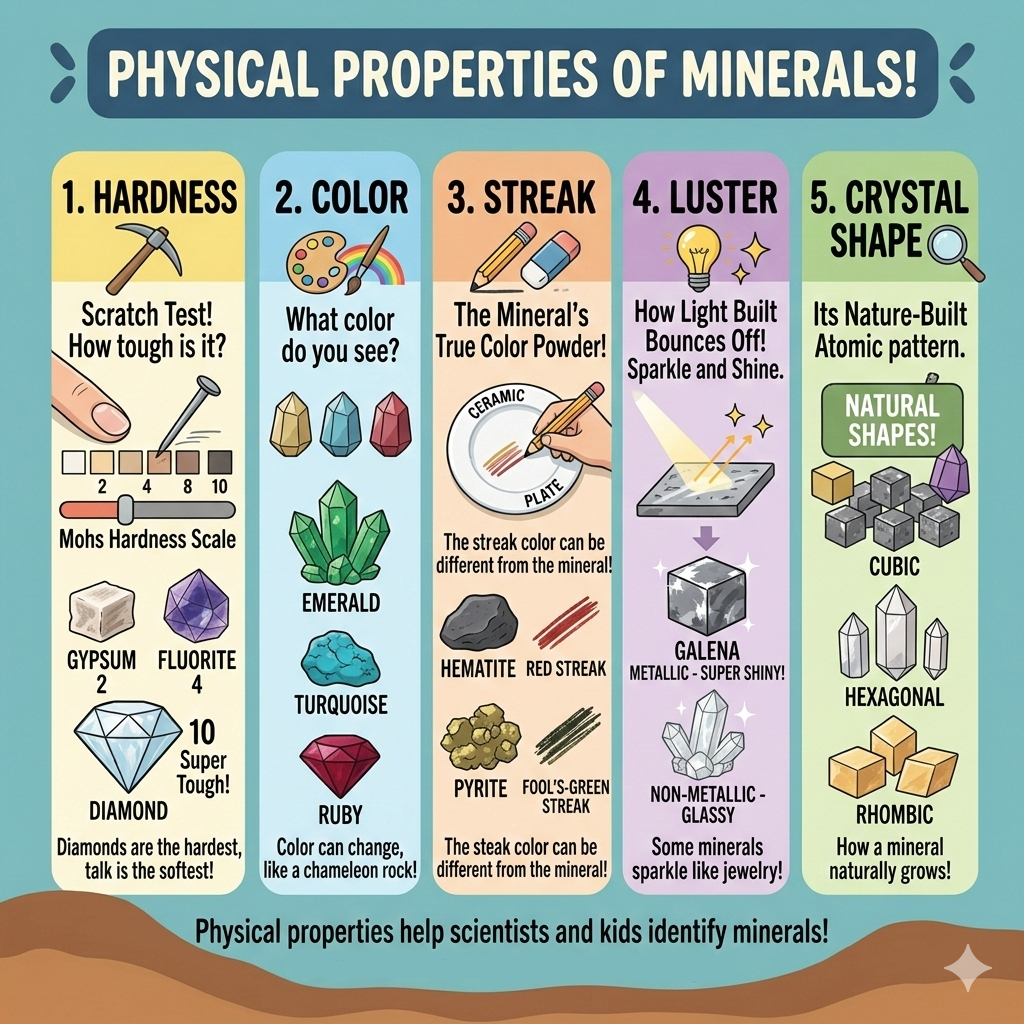
Minerals are identified by physical characteristics.
1. Hardness
Measured using the Mohs Hardness Scale.
Talc is very soft.
Diamond is the hardest known natural mineral.
2. Color
Color can help identify minerals, but it is not always reliable because some minerals appear in many colors.
3. Streak
The streak is the color of a mineral’s powder when scraped across a surface (typically an unglazed ceramic like a plate).
4. Luster
This describes how a mineral reflects light.
It can be:
- Metallic
- Glassy
- Dull
- Pearly
5. Crystal Shape
Minerals grow in specific patterns due to their atomic structure.
These patterns form recognizable crystal shapes.
Why Minerals Are Important
Minerals are not just museum pieces.
They are essential to modern life.
Nearly everything we use contains minerals.
Technology
Phones, computers, and batteries require minerals like:
- Lithium
- Copper
- Gold
- Silicon
Construction
Buildings and roads depend on:
- Limestone
- Gypsum
- Quartz
- Iron ores
Transportation
Cars, trains, and airplanes rely on:
- Aluminum
- Steel (from iron)
- Copper wiring
- Rare earth elements
Energy
Renewable energy systems also depend on minerals.
Solar panels and wind turbines require specific metals and rare elements.
Minerals support both traditional and modern technologies.
Why Responsible Use Matters
Because minerals are extracted from the Earth, responsible mining practices are important.
Extraction can impact:
- Landscapes
- Water systems
- Ecosystems
Many countries now work toward:
- Safer mining practices
- Reduced environmental damage
- Recycling of mineral-based materials
Understanding where materials come from helps us make informed choices.
The Value of Collecting Minerals
Collecting minerals and stones can be educational and inspiring.
For children, it encourages:
- Observation skills
- Pattern recognition
- Curiosity about geology
For adults, it offers:
- Appreciation of Earth’s history
- Calm, focused hobby time
- Connection to natural processes
Rock and mineral collecting can be meaningful when done responsibly.
Important guidelines include:
- Follow local laws
- Avoid protected areas
- Do not disturb ecosystems
- Leave enough for others to enjoy
Collecting can become a bridge between curiosity and care.
Minerals and Earth’s Story
Minerals record history.
Some crystals form over millions of years.
Some contain tiny inclusions that reveal ancient conditions.
Some help scientists understand how continents formed.
Rocks and minerals are like pages in Earth’s long story.
When you hold a mineral in your hand, you may be holding something that formed long before humans existed.
That perspective can be humbling.
Minerals in Daily Life
It is easy to think of minerals as distant and geological.
But they are everywhere.
Glass is made from quartz sand.
Table salt is a mineral.
Ceramics come from mineral-rich clay.
Jewelry uses precious minerals.
Concrete contains crushed rock and mineral materials.
Modern life quietly depends on geology.
Fun facts about Minerals & Stones
Minerals and stones are the building blocks of the Earth’s crust, formed through processes that take place deep underground, within volcanic systems, or through the slow evaporation of water. A mineral is defined by a specific chemical composition and crystal structure, which means that every sample of quartz, for example, shares the same internal arrangement of atoms. This structure determines how a mineral grows, how it reflects light, and even how it breaks. That is why some minerals split along smooth, flat planes while others fracture into curved or jagged shapes.
Crystals form when atoms arrange themselves in repeating patterns as molten rock cools or mineral-rich water evaporates. The speed of cooling affects crystal size — slow cooling deep underground allows large crystals to develop, while rapid cooling near the surface produces smaller ones. Many of the vibrant colors seen in gemstones come from trace elements. For instance, small amounts of chromium can give corundum a deep red color, creating ruby, while iron and titanium can produce the blue of sapphire. Even tiny chemical differences can dramatically change appearance.
Stones and rocks are made of one or more minerals combined together. Granite, for example, contains quartz, feldspar, and mica. Over time, rocks transform through the rock cycle — igneous rocks form from cooled magma, sedimentary rocks form from compressed layers of sediment, and metamorphic rocks change under heat and pressure. This continuous cycle means that the stone beneath your feet may have once been part of a mountain, ocean floor, or volcanic eruption millions of years ago. What appears solid and permanent is actually part of a long, ongoing story of pressure, temperature, and time shaping the Earth from within.
A Calm Reflection
The Liamming sits beside a crystal and does not rush to understand it.
It observes the angles.
The way light moves through it.
The layers within.
Minerals remind us that growth can be slow.
They form under pressure.
They form through heat.
They form through time.
And though they appear still, they are evidence of movement deep within Earth.
Understanding minerals is not only about classification.
It is about recognizing the quiet foundations of the world beneath our feet.
Suggested Reading & Books
The following books recommendations are accessible to parents, educators, and thoughtful readers.
- National Geographic Little Kids First Big Book of Rocks, Minerals & Shells
- The Rock and Gem Book: And Other Treasures of the Natural World (DK Our World in Pictures)
- Brown, Sarah – The Thinking Tree – Rocks & Minerals – Science Activity Book: For Active & Creative Kids – Ages 7 to 17 – Geology Homeschooling Workbook and Research Handbook
- National Geographic Kids Ultimate Rockopedia: The Most Complete Rocks & Minerals Reference Ever (NGK Ultimate Pedias)
- National Geographic Kids Rocks and Minerals Sticker Activity Book: Over 1,000 Stickers!
- Hello, World! Rocks and Minerals (Boardbook)
- Lewis, Gary – My Awesome Field Guide to Rocks and Minerals: Track and Identify Your Treasures
Sources & Further Reading
This article reflects scientific research and educational resources from leading institutions, including:
- U.S. Geological Survey (USGS) – Mineral resources and classification
https://www.usgs.gov - Smithsonian National Museum of Natural History – Mineral sciences department
https://naturalhistory.si.edu - Geological Society of America (GSA) – Earth science research
https://www.geosociety.org - British Geological Survey (BGS) – Mineral formation and use
https://www.bgs.ac.uk - Encyclopaedia Britannica – Minerals and Geology Overview
https://www.britannica.com
Readers are encouraged to explore these institutions for deeper geological study.