
How Volcanoes Create Islands
Some islands begin with fire.
Deep beneath the ocean’s surface, within the Earth, molten rock known as magma rises upward through cracks in the planet’s crust. When this magma reaches the surface, it erupts as lava, spreading and cooling into solid rock.
Over time, repeated volcanic eruptions build layer upon layer of hardened lava on the ocean floor. With each eruption, the structure grows taller. Eventually, what began far below the surface can rise above sea level — forming a new island.
This process is responsible for many volcanic island chains, including the Hawaiian Islands, which were formed over millions of years as the Pacific tectonic plate moved over a hotspot of volcanic activity.
Understanding how volcanoes create islands connects geology, plate tectonics, and Earth’s internal processes. It reveals how powerful forces beneath the surface shape the landscapes we see today — building land where there was once only open ocean.
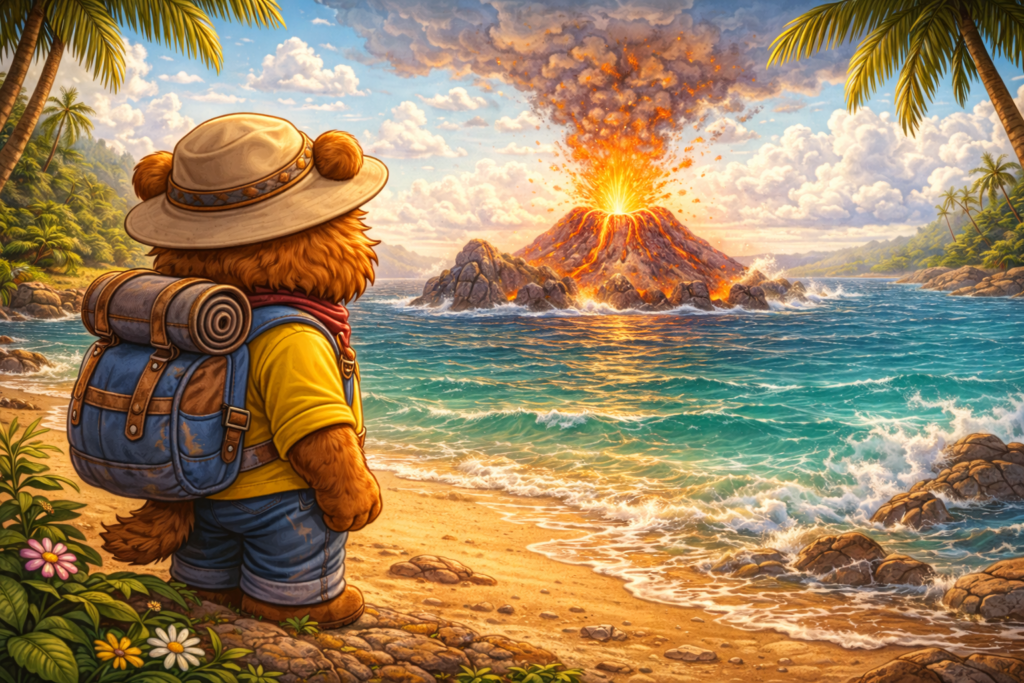
What Is a Volcano?
A volcano is an opening in Earth’s crust where molten rock, ash, and gases escape from below the surface.
Molten rock beneath Earth’s surface is called magma.
When magma erupts onto the surface, it is called lava.
Volcanoes can form on land or beneath the ocean.
Earth’s Layers and Moving Plates
To understand volcanic islands, we must first understand Earth’s structure.
Earth has several layers:
- Crust (outer layer)
- Mantle (beneath the crust)
- Core (deep interior)
The crust is broken into large sections called tectonic plates.
These plates slowly move over time.
Where plates meet, separate, or slide past each other, volcanic activity can occur.
Underwater Volcanoes
Many volcanoes form on the ocean floor.
At certain locations, magma rises through cracks in Earth’s crust beneath the ocean.
When underwater volcanoes erupt:
- Lava cools quickly in seawater.
- It hardens into solid rock.
- Layer upon layer builds upward.
Over thousands or millions of years, these layers can grow tall enough to reach the ocean’s surface.
When the top rises above sea level, a volcanic island is born.
The Hawaiian Islands: A Special Case
The Hawaiian Islands were formed by a process involving a hot spot.
A hot spot is a location deep in Earth’s mantle where unusually hot magma rises toward the surface.
Unlike most volcanoes that form at plate boundaries, Hawaii formed in the middle of the Pacific Plate.
Here is how it works:
- A hot spot remains mostly stationary deep within Earth.
- The Pacific tectonic plate slowly moves over it.
- As the plate moves, magma rises through the crust.
- A volcano forms and erupts repeatedly.
- Lava builds upward until an island forms.
Over time, as the plate continues moving, a chain of islands forms.
This is why Hawaii is made up of multiple islands in a line.
The youngest island, Hawaii (the “Big Island”), is still volcanically active.
Shield Volcanoes
The volcanoes in Hawaii are called shield volcanoes.
They have:
- Broad, gently sloping sides
- Lava that flows easily
- Less explosive eruptions compared to some other volcano types
Because the lava is thinner and flows more smoothly, it spreads out widely, creating the shield-like shape.
How Lava Builds Land
When lava flows into the ocean:
- The outer layer cools and hardens quickly.
- The inside remains hot and continues pushing forward.
- New rock forms where lava meets water.
Each eruption adds more rock.
Slowly, the island grows outward and upward.
Over long periods of time, this process creates mountains rising from the seafloor.
In fact, if measured from the ocean floor, Mauna Kea in Hawaii is taller than Mount Everest.
What Happens After an Island Forms?
Once a volcanic island rises above sea level, other natural processes begin shaping it.
Erosion
Wind, rain, and waves gradually wear down volcanic rock.
Plant Growth
Seeds carried by wind or birds begin to grow.
Over time, soil forms, plants spread, and ecosystems develop.
Coral Reefs
In tropical regions, coral reefs may grow around volcanic islands.
If the volcanic island slowly sinks over time, coral can continue growing upward, sometimes forming ring-shaped islands called atolls.
Volcanoes and Island Chains
Because tectonic plates move slowly (only a few centimeters per year), hot spots can create long chains of islands.
The Hawaiian Island chain stretches for thousands of miles across the Pacific Ocean.
Older islands are farther from the active hot spot and are more eroded.
Younger islands are closer to the hot spot and may still have active volcanoes.
This pattern helps scientists understand plate movement.
Why Volcanic Islands Matter
Volcanic islands:
- Create new land
- Support unique ecosystems
- Provide insight into Earth’s interior
- Help scientists study plate tectonics
They also shape culture and history.
In Hawaii, volcanoes hold deep cultural and spiritual significance.
Understanding volcanic island formation connects science with geography and tradition.
Fun facts about Volcanoes and Islands
Volcanoes are powerful geological features formed when molten rock, called magma, rises from deep within the Earth and reaches the surface. When magma erupts, it becomes lava, cooling and hardening into solid rock. Over time, repeated eruptions can build entire mountains. Some volcanoes form on the edges of tectonic plates, where plates collide or pull apart, while others form over “hot spots” — areas where heat from deep within the mantle rises steadily upward. These hot spots can create chains of volcanic islands as tectonic plates slowly move across them.
Many islands around the world, including the Hawaiian Islands, were formed by volcanic activity. As lava flows into the ocean and cools, it gradually builds upward from the seafloor. After many eruptions over thousands or millions of years, the volcano may rise above sea level, forming a new island. What begins as underwater activity eventually becomes solid land. Even after eruptions stop, erosion begins shaping the island — carving valleys, forming cliffs, and creating beaches from broken volcanic rock. This means volcanic islands are constantly changing, shaped first by fire and then by water and wind.
One fascinating detail is that volcanic soil is often extremely fertile. As lava breaks down over time, it releases minerals that enrich the ground, supporting lush plant life. This is why some volcanic islands are covered in dense forests and diverse ecosystems despite their fiery origins. Volcanoes may seem destructive, but they are also creators — building land, renewing soil, and even influencing global climate when large eruptions send ash and gases high into the atmosphere. Islands born from volcanoes are living reminders that Earth is not static, but dynamic and continuously reshaping itself.
Final Reflection
Volcanic islands begin beneath the ocean — unseen and powerful.
Magma rises. Lava cools. Rock builds. Land emerges.
Over time, fire creates land, and land supports life.
The Hawaiian Islands remind us that Earth is not still.
It moves. It reshapes itself. It builds mountains from the ocean floor.
Understanding how volcanoes create islands reveals the dynamic forces beneath our feet — and beneath the waves.
Suggested Reading & Books
The following books recommendations are accessible to parents, educators, and thoughtful readers.
- John, Samuel – Volcanoes For kids: Educational science book for learning about volcanoes
- Volcanoes (National Geographic Kids Readers, Level 2)
- Gibbons, Gail – Volcanoes
- Volcano: Images of Hawaii’s Volcanoes
Sources & Further Reading
The following trusted educational resources provide additional information about volcanoes, hot spots, and island formation:
- U.S. Geological Survey (USGS) – Hawaiian Volcano Observatory
https://www.usgs.gov/observatories/hvo - USGS – Volcanoes and How They Form
https://www.usgs.gov/programs/VHP/volcanoes - National Geographic – Volcanoes
https://www.nationalgeographic.com/environment/article/volcanoes - Smithsonian Institution – Global Volcanism Program
https://volcano.si.edu/ - NOAA – How Islands Form
https://oceanservice.noaa.gov/facts/island-formation.html
These resources are provided for educational purposes and to encourage deeper exploration of Earth’s geological systems.