
Learning Programming and Technology with Single-Board Computers
Small computers like the Raspberry Pi and NVIDIA Jetson Nano make it possible to explore programming, electronics, and artificial intelligence in a hands-on and accessible way.
At first glance, a single-board computer may look like a simple circuit board. Yet when connected to a keyboard, monitor, or camera, it becomes a fully functional computer — capable of running an operating system, connecting to the internet, controlling hardware, and executing complex programs.
These devices bring computer science into the physical world. Instead of working only on a screen, learners can interact directly with sensors, cameras, motors, and other components. Code is no longer just written — it is observed in action.
Single-board computers turn curiosity into experimentation. They allow learners to build projects, test ideas, and understand how software and hardware work together. From simple programs to advanced artificial intelligence applications, they provide a platform for exploration that grows with the learner’s skills.
By making technology more tangible and interactive, these tools help bridge the gap between theory and real-world application — encouraging creativity, problem-solving, and a deeper understanding of how modern systems are built.
What Is a Single-Board Computer?
A single-board computer (SBC) is a fully functioning computer built onto one circuit board.
It typically includes:
A processor (CPU)
Memory (RAM)
USB ports
Video output (HDMI)
Networking (Ethernet or Wi-Fi)
Input/output pins (GPIO)
Unlike large desktop systems with separate components, everything is integrated into one compact board.
Two of the most popular examples are:
Raspberry Pi
NVIDIA Jetson Nano
Both are powerful learning tools — but they focus on slightly different strengths.
What Is Raspberry Pi?
Raspberry Pi is a small, affordable computer originally designed to promote computer science education.
It runs a version of Linux and supports programming languages such as:
Python
C++
Scratch
JavaScript
Because it includes General Purpose Input/Output (GPIO) pins, Raspberry Pi can interact with the physical world.
You can:
Turn on LED lights
Control motors
Read temperature sensors
Build small robots
Create media centers
Host simple web servers
It connects code to electronics.
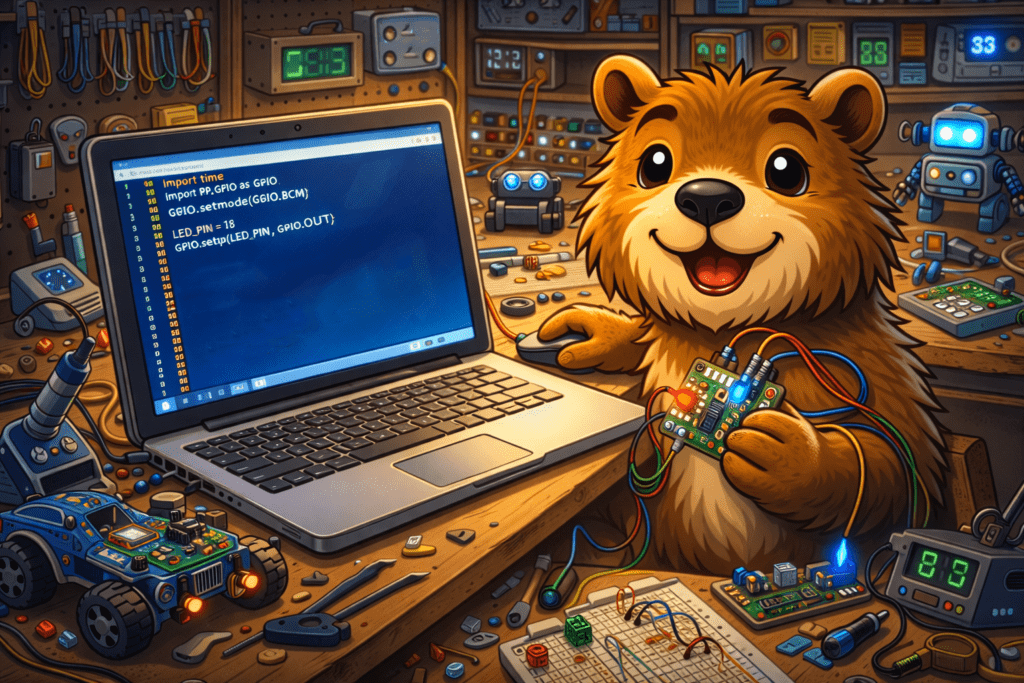
When a student writes a few lines of Python and a light turns on, programming becomes tangible.
What Is NVIDIA Jetson Nano?
The Jetson Nano is also a small single-board computer, but it is designed specifically for artificial intelligence and machine learning projects.
It includes:
- A CPU (for general computing)
- A powerful GPU (for parallel processing and AI tasks)
This allows it to run:
- Computer vision programs
- Object detection models
- Image classification systems
- AI-powered robotics
While Raspberry Pi focuses strongly on general learning and electronics, Jetson Nano specializes in AI development at the edge — meaning AI that runs locally instead of in the cloud.
This makes it ideal for:
Camera-based projects
Autonomous robotics
Real-time image processing
Why Single-Board Computers Are Powerful Learning Tools
Traditional computing often feels invisible.
You type on a keyboard. A screen changes. But the internal processes remain abstract.
Single-board computers reveal those layers.
They encourage learners to:
Install operating systems
Use the command line
Understand file systems
Configure networks
Connect hardware
Debug code
Learning becomes active instead of passive.
You are not just using technology.
You are building with it.
The Role of Programming
Programming is the language we use to communicate with computers.
On devices like Raspberry Pi and Jetson Nano, learners often begin with Python because it is readable and widely supported.
A simple Python example:
Turn on a light connected to a GPIO pin.
Capture an image from a camera.
Analyze that image using a machine learning model.
Display the result.
Each step builds understanding.
Programming teaches:
Logical thinking
Problem decomposition
Debugging strategies
Patience
Iteration
Mistakes are expected.
Errors are part of learning.
Each correction improves understanding.
Connecting Software to Hardware
One of the most powerful aspects of single-board computers is hardware interaction.
On a Raspberry Pi, you can:
Read data from a motion sensor.
Measure humidity and temperature.
Control a servo motor.
Trigger a camera when movement is detected.
On a Jetson Nano, you can:
Process live camera feeds.
Detect faces in real time.
Identify objects in an image.
Track movement.
Code produces visible outcomes.
Abstract logic becomes physical behavior.
Learning Artificial Intelligence at Home
AI often feels distant — something that exists only in large data centers.
But devices like Jetson Nano bring AI development into classrooms and homes.
Students can:
Train image classifiers
Run neural networks
Experiment with computer vision
Build autonomous vehicles in miniature form
Instead of only reading about machine learning, learners can see how models respond to real-world input.
AI becomes understandable when it is interactive.
Linux and Open-Source Learning
Both Raspberry Pi and Jetson Nano commonly use Linux-based operating systems.
Learning Linux introduces:
File permissions
Terminal commands
Software installation
Package management
System configuration
Open-source software allows learners to explore how systems work beneath the surface.
Transparency builds confidence.
You are not locked out of understanding the machine.
STEM Education and Real-World Skills
Single-board computers support STEM learning:
Science – sensors and data collection
Technology – coding and system configuration
Engineering – building circuits and devices
Mathematics – algorithms and computational logic
These skills connect directly to real-world careers:
- Software development
- Robotics engineering
- Cybersecurity
- Data science
- Embedded systems design
- AI research
But they also build something deeper:
Confidence in problem solving.
Fun Facts About Single-Board Computers & Programming
Raspberry Pi was first released in 2012 to encourage children to learn computer science affordably. Millions of units have been sold worldwide, supporting classrooms, hobbyists, and engineers alike. Despite its small size, a Raspberry Pi can run a full desktop operating system, host websites, control robots, or power digital displays. Jetson Nano, developed by NVIDIA, includes a GPU capable of running parallel computations, making it powerful enough to execute AI models that once required much larger systems. Both platforms demonstrate that computing power does not need to be physically large to be meaningful — efficiency and thoughtful design allow small boards to perform surprisingly advanced tasks. Around the world, students use these devices to build weather stations, automate greenhouses, create AI camera systems, and explore robotics in ways that make computer science hands-on and visible.
Learning Through Projects
Project-based learning strengthens understanding.
Examples include:
Building a weather station with sensors
Creating a home automation system
Programming a small rover
Designing a wildlife camera trap
Developing a simple AI object detector
Each project connects theory to practice.
Each experiment builds resilience.
If something fails, you troubleshoot.
If code crashes, you debug.
If wiring is incorrect, you adjust.
Learning becomes iterative and reflective.
Limitations and Realistic Expectations
Single-board computers are powerful but not limitless.
They have:
Less processing power than full desktops
Limited memory
Constraints in high-end gaming or heavy data processing
Understanding limitations is part of learning engineering trade-offs.
Design always involves balance:
Cost vs. performance
Power consumption vs. speed
Size vs. capability
The Calm Side of Building Technology
Building with single-board computers can feel surprisingly calm.
Wiring components carefully.
Typing commands deliberately.
Watching a program compile.
Observing a sensor reading stabilize.
There is rhythm in experimentation.
There is focus in debugging.
Technology does not need to feel rushed or overwhelming.
It can be explored steadily — one project at a time.
Final Reflection
Single-board computers like Raspberry Pi and Jetson Nano demonstrate that computing is not distant or abstract.
It is accessible.
It is buildable.
It is understandable.
With a small board, a power supply, and curiosity, learners can explore programming, electronics, and artificial intelligence in real time.
Code becomes visible.
Ideas become physical.
Questions become experiments.
Understanding computing is not about memorizing commands.
It is about building patiently.
Testing carefully.
Observing results.
And moving forward — curious, steady, and thoughtful.
Suggested Reading & Books
The following books introduce programming and computing concepts in accessible ways for learners of different ages:
- Halfacree, Gareth – The Official Raspberry Pi Beginner’s Guide
- Monk, Simon – Programming the Raspberry Pi: Getting Started with Python
- DK Workbooks: Raspberry Pi Projects: An Introduction to the Raspberry Pi Computer
Sources & Further Reading
The following trusted resources provide deeper information about single-board computing and AI development:
- Raspberry Pi Foundation – Official Documentation
https://www.raspberrypi.com/documentation/ - NVIDIA Developer – Jetson Nano Developer Kit
https://developer.nvidia.com/embedded/jetson-nano-developer-kit - Python Software Foundation – Python Documentation
https://docs.python.org/3/ - Linux Foundation – Introduction to Linux
https://training.linuxfoundation.org/resources/
These resources are provided for educational purposes and to encourage deeper exploration of computing, programming, and artificial intelligence.