
The Water Cycle: Movement, Change, and Renewal
Water on Earth is never still for long.
It moves continuously through oceans, rises into the atmosphere, forms clouds, falls as rain or snow, flows through rivers and streams, and eventually returns to the sea. This ongoing process is known as the water cycle.
The water cycle connects many of Earth’s systems. It influences weather and climate, shapes landscapes through rivers and glaciers, and supports all forms of life. Plants, animals, and humans all depend on this movement of water to survive, making it one of the most important natural processes on the planet.
Although the cycle involves many steps, it follows a steady and repeating pattern. Water changes form — from liquid to vapor to ice — and moves between land, sky, and sea in a continuous flow.
When understood step by step, the water cycle reveals a pattern of change and renewal. It shows how Earth’s systems remain connected, balanced, and constantly in motion — sustaining life across the planet.
What Is the Water Cycle?
The water cycle (also called the hydrologic cycle) is the process by which water moves between:
- The atmosphere (air)
- The land
- The oceans
Unlike many systems, the water cycle has no true beginning or end.
Water is reused again and again.
The same water molecules that exist today may have once flowed through ancient rivers or fallen as rain thousands of years ago.
Step 1: Evaporation
The cycle often begins with evaporation.
When the sun warms oceans, lakes, and rivers, some of the liquid water turns into invisible water vapor and rises into the air.
This happens because:
- Heat energy causes water molecules to move faster.
- Faster molecules escape into the air as gas.
Evaporation happens most strongly over oceans, which cover about 70% of Earth’s surface.
Step 2: Transpiration
Plants also play a role in the water cycle.
Through a process called transpiration, plants release water vapor from tiny openings in their leaves.
Water absorbed from the soil travels through the plant and eventually enters the atmosphere.
Together, evaporation and transpiration are sometimes called evapotranspiration.
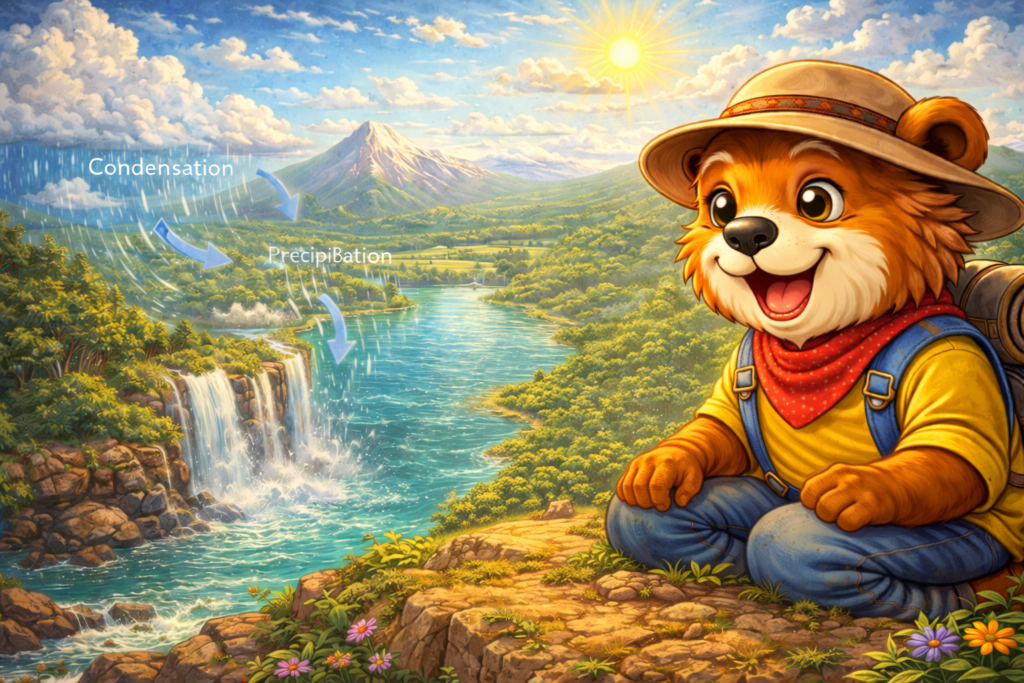
Step 3: Condensation
As water vapor rises, it moves into cooler parts of the atmosphere.
When water vapor cools, it changes back into tiny liquid droplets.
This process is called condensation.
Condensation forms:
- Clouds
- Fog
- Dew
Clouds are made of countless tiny water droplets or ice crystals suspended in the air.
Step 4: Precipitation
When droplets in clouds combine and grow large enough, gravity pulls them downward.
This falling water is called precipitation.
Precipitation can take different forms:
- Rain
- Snow
- Sleet
- Hail
The type depends on temperature conditions in the atmosphere.
Step 5: Collection and Runoff
After precipitation falls to Earth, it follows several paths.
Some water:
- Flows over land into rivers and streams (called runoff)
- Soaks into the ground (called infiltration)
- Collects in lakes or oceans
Water that enters the soil may become groundwater, slowly moving through underground layers of rock and sediment.
Eventually, much of this water returns to rivers or the ocean — and the cycle continues.
The Role of Gravity and Energy
Two main forces drive the water cycle:
The Sun
The sun provides the heat energy that powers evaporation.
Without solar energy, the cycle would slow dramatically.
Gravity
Gravity pulls precipitation downward and guides rivers toward lower elevations and eventually to the ocean.
Together, solar energy and gravity create a continuous loop of movement.
The Water Cycle and Weather
The water cycle directly affects weather patterns.
Cloud formation influences:
- Rainfall
- Storm development
- Humidity levels
Large-scale movements of water vapor also affect climate systems around the globe.
Regions near oceans often experience different weather patterns than inland areas because of moisture availability.
The Water Cycle and Landscapes
Flowing water shapes Earth’s surface.
Runoff and rivers can:
- Carve valleys
- Form waterfalls
- Create canyons
- Deposit sediment along floodplains
Over long periods of time, moving water reshapes mountains and coastlines.
The water cycle is not only about movement — it is about transformation.
The Water Cycle and Living Things
All living organisms depend on water.
The water cycle ensures that freshwater is distributed across the planet.
Humans rely on it for:
- Drinking water
- Agriculture
- Hydroelectric power
- Industry
Plants and animals depend on consistent rainfall and groundwater supplies.
A balanced water cycle supports healthy ecosystems.
Human Influence on the Water Cycle
Human activities can affect the water cycle.
For example:
- Urban development changes how water flows over land.
- Deforestation reduces transpiration.
- Climate change influences evaporation and precipitation patterns.
Understanding the water cycle helps communities manage water resources responsibly.
Observing the Water Cycle in Everyday Life
You can see parts of the water cycle in daily experiences:
- Steam rising from hot pavement after rain
- Morning dew on grass
- Clouds forming over mountains
- Rivers flowing toward the sea
Even a quiet shoreline reflects the cycle in motion.
Water evaporates, travels, falls, and returns.
The movement is steady, continuous, and patient.
Fun facts about the Water Cycle
The water cycle is the continuous movement of water through Earth’s atmosphere, land, and oceans, and it has been operating for billions of years. The same water molecules that fall as rain today may once have flowed through ancient rivers or even existed when dinosaurs roamed the planet. The cycle is powered primarily by the Sun, which heats surface water in oceans, lakes, and rivers, causing it to evaporate into water vapor. Plants also contribute through a process called transpiration, releasing moisture from their leaves into the air. Together, evaporation and transpiration move vast amounts of water upward into the atmosphere each day.
As water vapor rises, it cools and condenses into tiny droplets, forming clouds. When those droplets combine and grow heavy enough, they fall back to Earth as precipitation — rain, snow, sleet, or hail. Not all precipitation immediately returns to rivers or oceans. Some soaks into the ground, replenishing underground aquifers that store freshwater for years or even centuries. Some becomes runoff, flowing across land into streams and eventually back to the sea. In colder regions, water may be stored temporarily as glaciers or snowpack, slowly melting and feeding rivers long after a storm has passed.
One fascinating aspect of the water cycle is how interconnected it is. A drop of water that evaporates from the Pacific Ocean may later fall as snow in the mountains, flow through a river system, and eventually return to the ocean again. Despite constant movement, the total amount of water on Earth remains relatively stable. What changes is its location and state — liquid, solid, or gas. The water cycle is both simple in concept and vast in scale, quietly shaping weather patterns, ecosystems, agriculture, and daily life across the planet.
Final Reflection
The water cycle is one of Earth’s most elegant systems.
It connects sky and sea. It shapes valleys and waterfalls. It nourishes forests and fields.
Water changes form — liquid, vapor, ice — but it remains part of the same continuous journey.
When viewed calmly, the water cycle is not complicated.
It is a steady rhythm powered by sunlight and guided by gravity.
And it reminds us that even constant motion can feel balanced and interconnected.
- Moon, Emily Kate – Drop: An Adventure through the Water Cycle (A Science Pals Book)
- Water Cycles (DK Life Cycles)
- Water (National Geographic Kids Readers, Level 3)
- Scholastic – The Water Cycle (Learn About: Water)
- Paterson, John – I Am the Rain: A Science Book for Kids about the Water Cycle and Change of Seasons (Includes STEM activities, water conservation tips, and more)
Suggested Reading & Books
The following books recommendations are accessible to parents, educators, and thoughtful readers.
Sources & Further Reading
The following trusted educational resources provide additional information about the water cycle and Earth’s freshwater systems:
- U.S. Geological Survey (USGS) – The Water Cycle
https://www.usgs.gov/special-topics/water-science-school/science/water-cycle - NOAA – The Water Cycle Overview
https://www.noaa.gov/education/resource-collections/freshwater/water-cycle - NASA Earth Observatory – The Water Cycle
https://earthobservatory.nasa.gov/features/Water - National Geographic – Water Cycle
https://www.nationalgeographic.org/encyclopedia/water-cycle/
These resources are provided for educational purposes and to encourage continued exploration of Earth’s natural systems.