
How Ecosystems Stay Balanced — and Why It Matters
Ecosystems are all around us, quietly supporting life in ways that are easy to overlook. From forests and deserts to oceans and wetlands, each environment is made up of living and nonliving elements working together as a connected system.
An ecosystem includes plants, animals, insects, water, soil, sunlight, and air — all interacting in ways that allow life to exist and continue. These interactions form relationships that help regulate populations, cycle nutrients, and move energy through the environment.
Balance in an ecosystem does not mean that nothing changes. Nature is constantly shifting. Seasons change, populations rise and fall, and environmental conditions vary over time. What makes an ecosystem balanced is its ability to adjust to these changes without breaking down.
When the relationships within an ecosystem remain healthy, the system can continue to support life, recover from disturbances, and adapt to new conditions. Understanding how ecosystems stay balanced helps us better appreciate how forests grow, how deserts sustain life, and how oceans support complex marine environments.
It also helps us recognize how closely everything in nature is connected — and why those connections matter.
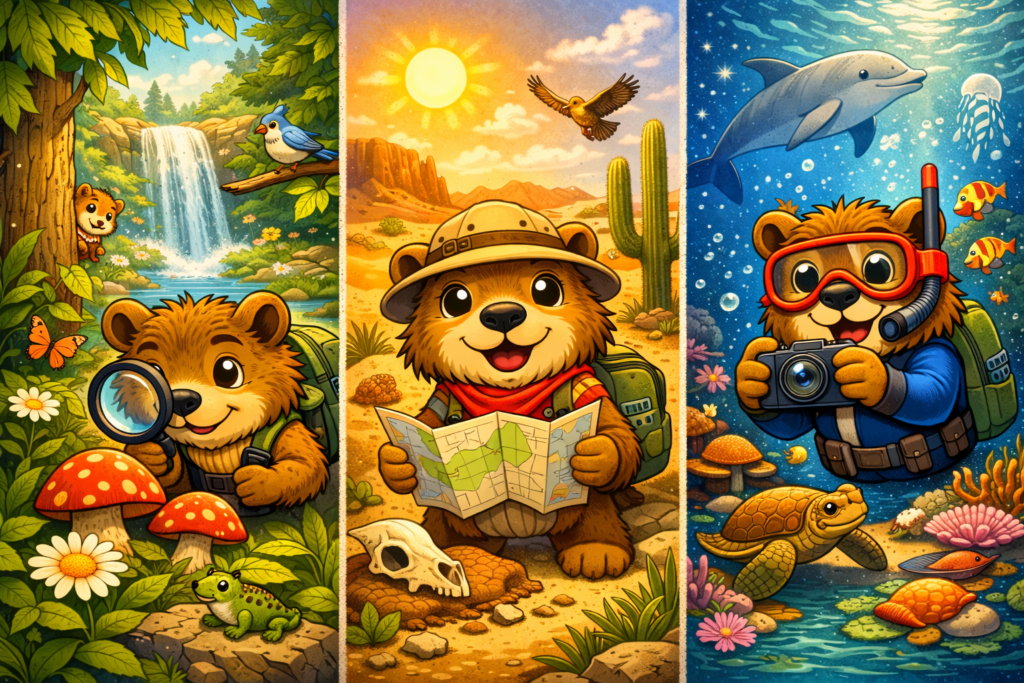
What Is an Ecosystem?
An ecosystem includes:
- Living things (biotic factors): plants, animals, fungi, bacteria
- Nonliving things (abiotic factors): sunlight, water, soil, air, temperature
All of these parts depend on one another.
For example:
- Plants need sunlight and water.
- Animals need plants or other animals for food.
- Decomposers break down dead material and return nutrients to the soil.
When these relationships work together, the system remains stable.
Energy Flow: The Foundation of Balance
Every ecosystem depends on energy from the sun.
Step 1: Producers
Plants and algae are called producers because they make their own food through photosynthesis.
They convert sunlight into energy stored in plant tissues.
Step 2: Consumers
Animals are consumers. They eat plants or other animals to gain energy.
Step 3: Decomposers
Fungi, bacteria, and some insects break down dead organisms.
They return nutrients to the soil or water so plants can grow again.
Energy flows in one direction — from the sun through producers to consumers.
Nutrients, however, are recycled again and again.
Forest Ecosystems
Forests are rich ecosystems filled with trees, shrubs, insects, birds, mammals, and fungi.
How Forests Stay Balanced
- Trees provide shade and shelter.
- Leaves fall and decompose, enriching soil.
- Insects and fungi break down dead wood.
- Predators help control herbivore populations.
For example, if deer populations grow too large, they may overgraze young plants. Predators such as wolves or mountain lions help regulate herbivore numbers.
Forests also depend on periodic natural disturbances, such as low-intensity fires. These can clear old growth and allow new plants to sprout.
When the parts work together, forests renew themselves.
Forest Ecosystem facts: Forest ecosystems cover about one-third of Earth’s land surface and are among the most complex and diverse environments on the planet. They range from tropical rainforests near the equator to temperate forests with four distinct seasons and boreal forests that stretch across colder northern regions. One fascinating fact is that tropical rainforests, though covering a relatively small percentage of Earth’s surface, contain more than half of the world’s plant and animal species. Their dense canopies create multiple vertical layers — forest floor, understory, canopy, and emergent layer — each supporting different forms of life.
Forests are often called the “lungs of the Earth” because trees absorb carbon dioxide during photosynthesis and release oxygen. In doing so, they help regulate the global climate. Trees also store large amounts of carbon in their trunks, roots, and surrounding soil. Beyond climate, forests influence local weather patterns by releasing water vapor through transpiration, which contributes to cloud formation and rainfall. In some regions, forests even help stabilize temperatures and reduce the intensity of floods by slowing water runoff with their root systems.
Beneath the forest floor lies an equally fascinating network. Tree roots often connect with fungi in a partnership known as mycorrhizae. These underground fungal networks help trees exchange nutrients and may even allow them to “communicate” chemical signals when under stress. Fallen leaves and decaying wood are broken down by insects, fungi, and microorganisms, recycling nutrients back into the soil. Forest ecosystems are not static collections of trees; they are living systems shaped by fire, storms, growth, and renewal. Over time, forests move through cycles of disturbance and regrowth, demonstrating resilience and intricate interdependence among countless species.
Desert Ecosystems
Deserts may look empty, but they are carefully balanced systems.
Water is limited, so plants and animals must adapt.
How Deserts Stay Balanced
- Plants like cacti store water.
- Many animals are active at night to avoid heat.
- Predators regulate rodent populations.
- Seeds may remain dormant until rainfall arrives.
Because resources are scarce, even small changes can affect balance.
For example, if rainfall patterns shift, plant growth changes. This affects herbivores, which then affects predators.
Desert ecosystems are fragile but resilient when conditions remain stable.
Desert Ecosystems facts: Desert ecosystems cover about one-fifth of Earth’s land surface and are defined not by heat, but by low precipitation. While many deserts are hot and sandy, others — like Antarctica — are technically deserts because they receive very little rainfall. One fascinating fact is that desert temperatures can swing dramatically between day and night. With little moisture or cloud cover to trap heat, some hot deserts experience scorching daytime temperatures and surprisingly cold nights within the same 24-hour period.
Plants and animals in desert ecosystems have developed remarkable adaptations to conserve water and survive extreme conditions. Cacti, for example, store water in thick stems and use spines instead of leaves to reduce water loss and deter herbivores. Many desert plants have shallow, widespread root systems that quickly absorb rain before it evaporates. Animals such as fennec foxes, kangaroo rats, and certain reptiles are often nocturnal, becoming active at night when temperatures are cooler. Some species can survive with little to no direct drinking water, obtaining moisture entirely from the food they consume.
Deserts are also shaped by wind and geological time. Sand dunes form as wind moves and deposits sand into ridges and waves that constantly shift position. In rocky deserts, erosion sculpts dramatic landscapes of arches, mesas, and canyons. Despite appearing sparse, desert ecosystems support specialized biodiversity and complex food webs. Seasonal rains can trigger sudden bursts of wildflowers, temporarily transforming dry landscapes into vibrant fields of color. What may seem like empty terrain at first glance is actually a finely balanced system where life persists through efficiency, timing, and adaptation.
Ocean Ecosystems
Oceans cover about 70% of Earth’s surface.
They contain diverse ecosystems, including coral reefs, kelp forests, and deep-sea environments.
How Oceans Stay Balanced
- Phytoplankton (tiny plant-like organisms) produce oxygen and form the base of the food web.
- Small fish eat plankton.
- Larger fish eat smaller fish.
- Decomposers recycle nutrients in water and sediment.
In coral reef ecosystems, balance depends on cooperation between coral animals and algae.
If water temperature rises too much, this relationship can break down, causing coral bleaching.
Healthy ocean systems rely on stable temperatures, clean water, and balanced predator-prey relationships.
Ocean Ecosystems facts: Ocean ecosystems make up the largest living system on Earth, covering more than 70% of the planet’s surface and containing a vast range of habitats from sunlit coral reefs to the darkest ocean trenches. One fascinating fact is that most ocean life depends on microscopic organisms called phytoplankton. These tiny, photosynthetic drifters float near the surface and produce a significant portion of the oxygen in Earth’s atmosphere. Though invisible to the naked eye, they form the base of marine food webs, supporting everything from small fish to massive whales.
Ocean ecosystems are divided into zones based on depth and light availability. The sunlit zone, or photic zone, supports coral reefs, sea grasses, and the majority of marine species because sunlight allows photosynthesis to occur. Below that lies the twilight zone, where light fades and creatures often develop large eyes or bioluminescence to survive. In the deep ocean, where sunlight never reaches, some ecosystems rely not on photosynthesis but on chemosynthesis — bacteria that use chemicals from hydrothermal vents to create energy. Around these vents, entire communities of unusual organisms thrive in complete darkness under extreme pressure.
Ocean ecosystems also regulate global climate and weather. Major currents, such as the Gulf Stream, redistribute heat around the planet, influencing temperature patterns across continents. Coastal ecosystems like mangroves and kelp forests provide shelter for young marine species and act as buffers against storms. Coral reefs, though covering a small fraction of the ocean floor, support immense biodiversity and protect shorelines from wave erosion. Despite their size and resilience, ocean ecosystems are sensitive to changes in temperature, pollution, and overfishing. The ocean is not just a distant expanse of water — it is a dynamic, interconnected system that sustains life on Earth in visible and invisible ways.
Food Webs: Connections Within Ecosystems
Ecosystems are often described using food webs.
A food web shows how different organisms are connected through feeding relationships.
Unlike a simple food chain, food webs show many connections.
If one species declines, others may adjust.
This flexibility helps ecosystems remain stable.
Keystone Species
Some species have a greater impact on balance than others.
These are called keystone species.
For example:
- Sea otters help control sea urchin populations, protecting kelp forests.
- Wolves can influence entire forest systems by regulating deer populations.
When keystone species disappear, ecosystems can shift dramatically.
Natural Change vs. Human Impact
Ecosystems naturally change over time due to:
- Weather patterns
- Seasonal cycles
- Natural disturbances
However, human activities can cause faster changes, such as:
- Deforestation
- Pollution
- Overfishing
- Climate change
When change happens too quickly, ecosystems may struggle to adjust.
Understanding balance helps communities protect natural systems.
How You Can Observe Ecosystem Balance
Even during simple travel experiences, you can observe ecosystem interactions:
- Birds feeding on insects in a forest
- Lizards hunting in desert heat
- Tide pools showing predator-prey relationships
Calm observation helps us notice connections.
Nature’s balance is not silent — it is steady and interconnected.
Fun facts about Earth’s Ecosystems
Ecosystems are communities of living organisms interacting with each other and with their physical environment — including air, water, soil, and sunlight. They exist at many scales, from a small pond to an entire rainforest. One fascinating fact is that ecosystems are powered primarily by the Sun. Through photosynthesis, plants, algae, and certain bacteria convert sunlight into energy, forming the base of the food web. This energy then moves through herbivores, predators, and decomposers in a continuous flow. Without producers capturing sunlight, most life on Earth would not be possible.
Earth contains a wide variety of ecosystems, each shaped by climate and geography. Tropical rainforests are among the most biodiverse, housing more species per square mile than almost anywhere else. Deserts, though often seen as empty, support specially adapted plants and animals that conserve water and tolerate extreme temperatures. Coral reefs occupy less than 1% of the ocean floor yet support roughly 25% of all marine species. Even polar regions, with freezing temperatures and long winters, contain complex ecosystems where organisms have adapted to survive with limited sunlight for part of the year.
Ecosystems are dynamic rather than fixed. They change over time through processes such as succession, where plant and animal communities gradually replace one another after disturbances like fires or volcanic eruptions. Keystone species, such as wolves in certain forests or sea otters in kelp ecosystems, can have a disproportionately large impact on maintaining balance. When one species is removed, ripple effects can travel throughout the entire system. Despite their complexity, ecosystems operate through interconnected relationships — a reminder that life on Earth depends not only on individual organisms, but on the networks that link them together.
One of the rarest ecosystems on Earth is found around deep-sea hydrothermal vents — cracks in the ocean floor where superheated, mineral-rich water rises from beneath Earth’s crust. These ecosystems were only discovered in 1977, and they completely changed scientific understanding of life on our planet. Unlike most ecosystems, which depend on sunlight for energy, hydrothermal vent communities rely on chemosynthesis. Specialized bacteria convert chemicals such as hydrogen sulfide from vent fluids into energy, forming the base of a food web that exists in total darkness thousands of feet below the surface.
The conditions around these vents are extreme. Water temperatures near vent openings can exceed 700°F (370°C), yet the surrounding deep ocean remains just above freezing. The pressure is immense — hundreds of times greater than at sea level. Despite this, unique organisms thrive there, including giant tube worms that can grow over six feet long, clams the size of dinner plates, and shrimp with light-sensitive organs on their backs instead of traditional eyes. Many of these species exist nowhere else on Earth, making the ecosystem both rare and highly specialized.
Hydrothermal vent ecosystems are also temporary on geological timescales. They form in volcanically active regions along mid-ocean ridges, and when volcanic activity shifts, vents can cool and become inactive. This means the communities that depend on them must either migrate or perish. Scientists study these rare ecosystems not only to understand biodiversity but also to explore clues about how life may have originated on early Earth — and how it might exist on other planets or moons with subsurface oceans. In the darkest parts of the sea, far from sunlight, life has found a completely different way to flourish.
Final Reflection
Ecosystems stay balanced through relationships.
Energy flows from the sun. Nutrients cycle through soil and water. Predators regulate populations. Plants anchor the system.
Forests, deserts, and oceans each operate differently, but they all depend on cooperation among living and nonliving parts.
Balance in nature is not about perfection.
It is about steady interaction over time.
When we understand these systems, we become more thoughtful travelers and caretakers of the planet.
Suggested Reading & Books
The following books recommendations are accessible to parents, educators, and thoughtful readers.
- DK Super Planet Essential Ecosystems
- Earth’s Biosphere (Understanding Earth’s Systems)
- Habitats of the World (DK Panorama)
- The Wondrous Workings of Planet Earth: Understanding Our World and Its Ecosystems – R. Ignotofsky
- Biomes: Discover the Earth’s Ecosystems with Environmental Science Activities for Kids (Build It Yourself)
Sources & Further Reading
The following trusted educational resources provide reliable information about ecosystems and ecological balance:
- National Geographic – Ecosystems Overview
https://www.nationalgeographic.org/encyclopedia/ecosystem/ - U.S. Environmental Protection Agency (EPA) – Ecosystems
https://www.epa.gov/report-environment/ecosystems - National Park Service – Forest and Desert Ecosystems
https://www.nps.gov/subjects/ecology/index.htm - NOAA – Ocean Ecosystems
https://www.noaa.gov/education/resource-collections/ocean-coasts/ocean-ecosystems - Smithsonian National Museum of Natural History – Ecology Resources
https://naturalhistory.si.edu/education
These resources are provided for educational purposes and to encourage deeper exploration of ecological systems and conservation.