
How GPS Works and How Satellites Help Us Navigate
When you open a map app and see a small blue dot showing your location, something remarkable is happening behind the scenes.
Within seconds, your device connects with satellites orbiting high above the Earth. Using precise timing, signals, and calculations based on math and physics, it determines your exact position on the planet — often within just a few meters.
This system is called GPS, or Global Positioning System.
GPS is a network of satellites, ground stations, and receivers that work together to provide accurate location and navigation information anywhere on Earth. It allows people to find directions, measure distances, track movement, and explore unfamiliar places with confidence.
What makes GPS especially powerful is how it connects multiple fields of science. It relies on space technology, mathematics, physics, and engineering — all working together to create a tool that people use every day without often thinking about how it works.
By understanding GPS, we begin to see how invisible systems guide real-world movement, helping us navigate not only across cities and countries, but across the entire planet.
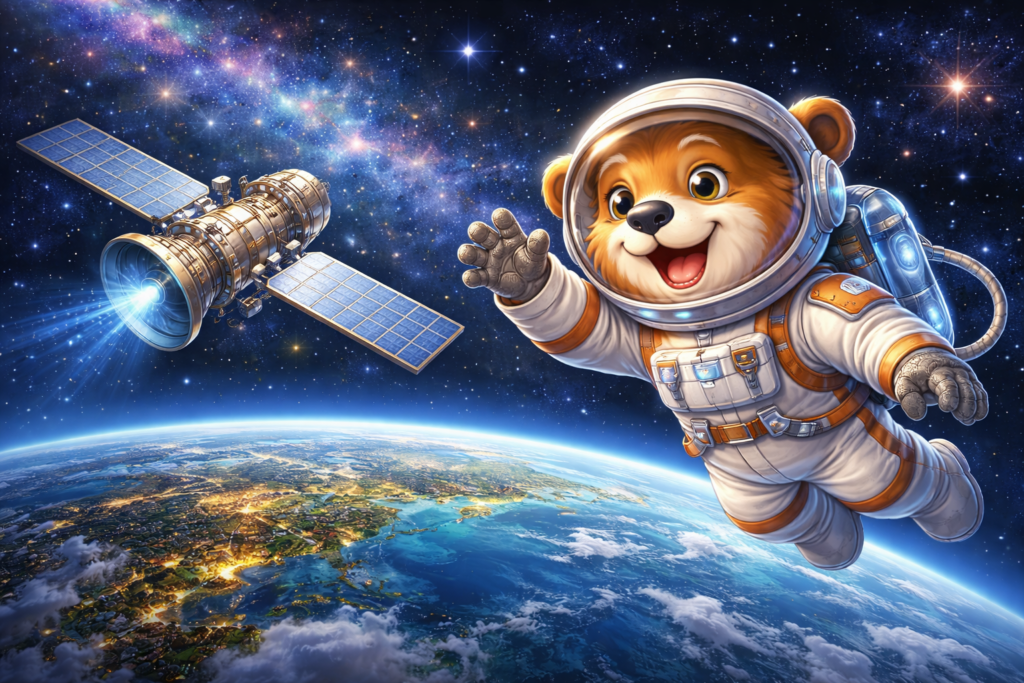
What Is GPS?
GPS is a satellite-based navigation system that allows devices on Earth to determine their exact location.
It can tell you:
- Where you are
- How far you are from a destination
- How long it may take to arrive
- Which route is fastest
GPS works anywhere on Earth — on land, at sea, and in the air.
Where Did GPS Come From?
GPS was developed by the United States Department of Defense in the 1970s.
Originally, it was designed for military navigation.
In the 1980s and 1990s, GPS technology became available for civilian use. Over time, it became more accurate and widely used.
Today, GPS supports:
- Airplane navigation
- Shipping routes
- Emergency services
- Scientific research
- Everyday driving and walking directions
The Satellites in Space
At the heart of GPS is a network of at least 24 satellites orbiting Earth.
These satellites:
- Orbit about 12,500 miles (20,000 kilometers) above Earth
- Travel at speeds of about 8,700 miles per hour
- Circle the planet twice each day
Because the satellites are spaced evenly around Earth, at least four are usually visible from any location.
How GPS Finds Your Location
GPS works using a method called trilateration.
This method uses distance measurements from multiple satellites.
Here is how it works step by step:
Step 1: Satellite Signals
Each GPS satellite constantly sends out a radio signal.
This signal contains:
- The satellite’s position
- The exact time the signal was sent
Step 2: Measuring Time
Your phone or GPS device receives the signal.
Because radio waves travel at the speed of light, the device calculates how long the signal took to arrive.
Distance = Speed × Time
If the signal took 0.07 seconds to arrive, your device multiplies that time by the speed of light to estimate how far away the satellite is.
Step 3: Drawing Invisible Spheres
If you know your distance from one satellite, you could be anywhere on an invisible sphere around it.
With two satellites, you narrow your location to where two spheres intersect.
With three satellites, the location becomes even more precise.
With four satellites, your exact position in three dimensions (latitude, longitude, and altitude) can be calculated.
This is trilateration in action.
The Importance of Atomic Clocks
GPS requires extremely precise timing.
Even an error of one millionth of a second could cause location errors of hundreds of meters.
Each GPS satellite carries an atomic clock.
Atomic clocks are incredibly accurate — they measure time based on the vibrations of atoms.
This precision allows GPS calculations to remain accurate.
The Role of Math
GPS relies heavily on mathematics, including:
- Geometry (measuring distances in space)
- Algebra (solving equations)
- Physics (understanding signal speed)
- Trigonometry (angles and positioning)
Without math, the system would not function.
The blue dot on your phone is the result of continuous mathematical calculations.
GPS and Travel
GPS has transformed how people travel.
Before GPS, navigation required:
- Paper maps
- Compasses
- Road signs
- Careful planning
Today, GPS helps travelers:
- Avoid traffic
- Estimate arrival times
- Find hiking trails
- Navigate unfamiliar cities
Pilots, ship captains, and emergency responders also rely on GPS for safety.
GPS and Everyday Life
GPS supports many systems beyond driving directions.
It helps with:
- Delivery services
- Weather tracking
- Disaster response
- Scientific studies of Earth’s movement
- Monitoring tectonic plate shifts
Farmers use GPS-guided equipment to plant crops efficiently.
Scientists use GPS to measure tiny movements in Earth’s crust.
GPS Is Not the Only System
While GPS was developed in the United States, other countries have similar systems:
- GLONASS (Russia)
- Galileo (European Union)
- BeiDou (China)
Many modern devices use signals from multiple systems for improved accuracy.
Limitations of GPS
GPS signals can be weakened or blocked by:
- Tall buildings
- Mountains
- Dense forests
- Underground locations
This is why location services sometimes lose accuracy indoors.
Engineers continue improving technology to overcome these limitations.
Fun facts about Satellites & GPS
Satellites are objects that orbit a planet, and while the Moon is Earth’s natural satellite, thousands of artificial satellites now circle the planet as well. These human-made satellites serve many purposes — communication, weather forecasting, scientific research, television broadcasting, and navigation. Most satellites orbit at carefully calculated speeds and altitudes so that Earth’s gravity pulls them inward while their forward motion keeps them from falling. This balance creates a continuous freefall around the planet, allowing them to remain in orbit for years.
GPS, or Global Positioning System, relies on a network of at least 24 satellites orbiting Earth approximately 12,500 miles above the surface. Each satellite constantly transmits a signal containing its precise time and position. Your phone or GPS device does not send information outward to find your location; instead, it listens. By calculating how long signals take to arrive from multiple satellites, the device determines your distance from each one. Using a method called trilateration, it pinpoints your exact position on Earth — often within just a few meters.
One fascinating detail is that GPS depends on extremely accurate atomic clocks aboard the satellites. These clocks are so precise that even tiny differences in time — billionths of a second — matter. In fact, adjustments must account for effects predicted by Einstein’s theory of relativity, because time moves slightly differently in orbit than it does on Earth’s surface. Without those corrections, GPS measurements would quickly drift off course. What feels like a simple tap on a map is actually the result of space technology, physics, and mathematics working together seamlessly above our heads every day.
Final Reflection
GPS may feel ordinary because we use it daily.
But behind each location update is a network of satellites, atomic clocks, radio signals, and advanced mathematics.
Signals travel from space to your hand in less than a second.
Geometry determines your position.
Physics ensures signals move at predictable speeds.
Technology quietly connects Earth and space.
Understanding GPS shows how math and science guide us calmly across the world.
Suggested Reading & Books
The following books explore the science of play, brain development, creativity, adolescence, and intrinsic motivation. These are accessible to parents, educators, and thoughtful readers.
- Taylor, Jessica – How do satellites stay in space?
- Peridot, Kate – Satellites: Learn all about satellites and their special missions to connect, inform, and protect all of us
Sources & Further Reading
The following trusted educational resources provide more information about GPS and satellite navigation:
- NASA – Global Positioning System Overview
https://www.nasa.gov/directorates/heo/scan/communications/policy/GPS/ - NOAA – How GPS Works
https://oceanservice.noaa.gov/facts/gps.html - U.S. Space Force – GPS.gov Official Site
https://www.gps.gov - National Geographic – How GPS Works
https://www.nationalgeographic.org/article/how-gps-works/ - Smithsonian National Air and Space Museum – Satellite Navigation
https://airandspace.si.edu/stories/editorial/how-does-gps-work
These resources are provided for educational purposes and to encourage deeper exploration of satellite technology and navigation science.