
How Fossils Form and How Ancient Life Is Preserved
Fossils offer a unique window into the past, allowing us to explore life that existed long before humans. From towering dinosaurs to small shells preserved in stone, fossils provide direct evidence of plants and animals that lived millions of years ago.
When you see a fossil in a museum, you are not just looking at an object — you are seeing the result of natural processes that have preserved traces of ancient life over vast stretches of time. These preserved remains help scientists understand how organisms lived, how environments changed, and how life on Earth has evolved.
Fossils do not form quickly or easily. They require specific conditions, such as rapid burial, the presence of sediment, and the gradual replacement or preservation of organic material. Over time, layers of rock protect and transform these remains, turning them into lasting records of the past.
Understanding how fossils form connects biology, geology, and Earth’s deep history. It reveals how living organisms become part of the geological record and how the planet preserves its own story across millions of years.
What Is a Fossil?
A fossil is the preserved remains or traces of a once-living organism.
Fossils can include:
- Bones
- Teeth
- Shells
- Leaves
- Footprints
- Burrows
- Impressions in rock
Most fossils are found in sedimentary rock — rock formed from layers of sand, mud, or sediment pressed together over time.
Why Fossils Are Rare
Most plants and animals do not become fossils.
After death, organisms usually:
- Decompose
- Are eaten by scavengers
- Break apart due to weather
For a fossil to form, the remains must be buried quickly, often by:
- Mudslides
- River sediment
- Volcanic ash
- Ocean floor sediment
Rapid burial protects the remains from decay and disturbance.
The Most Common Type: Permineralization
One of the most common fossil formation processes is called permineralization.
Here is how it works:
- An organism dies and is buried by sediment.
- Over time, layers of sediment build above it.
- Groundwater carrying dissolved minerals flows through the buried remains.
- Minerals fill tiny spaces inside bones or wood.
- The minerals harden, preserving the structure.
Eventually, the original material may be replaced by stone, but the shape remains.
This process can take thousands to millions of years.
Mold and Cast Fossils
Sometimes the original organism dissolves completely.
If it leaves an empty imprint in the rock, that imprint is called a mold.
If minerals later fill that mold and harden, a cast fossil forms.
This often happens with shells and marine organisms.
Trace Fossils
Not all fossils are body parts.
Some fossils record activity instead of remains.
These are called trace fossils.
Examples include:
- Footprints
- Trackways
- Burrows
- Fossilized nests
Trace fossils help scientists understand behavior — how animals moved, hunted, or lived.
Fossils and Sedimentary Rock
Fossils are most commonly found in sedimentary rock because:
- Sediment builds up gradually.
- Pressure increases slowly.
- Heat is not intense enough to destroy remains.
Igneous rock (from lava) and metamorphic rock (changed by extreme heat and pressure) usually destroy fossils.
This is why paleontologists search in ancient riverbeds, deserts, and layered rock formations.
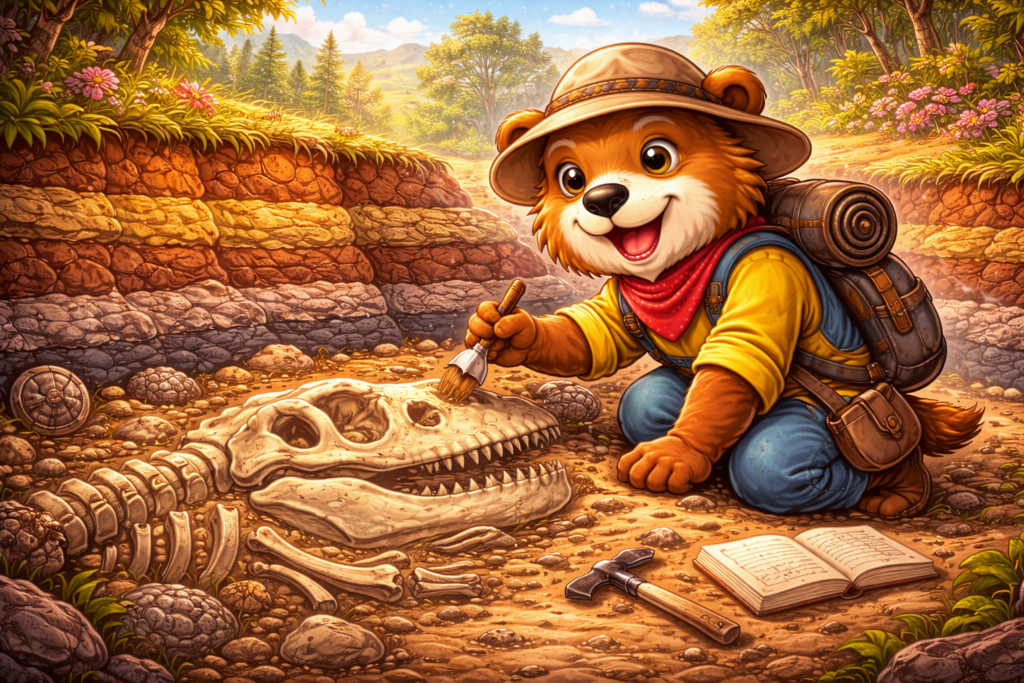
How Fossils Are Discovered
Wind and water erosion slowly expose buried fossils.
Scientists look for:
- Unusual shapes in rock
- Bone fragments on the surface
- Patterns in sediment layers
Excavation requires careful tools and patience.
Once removed, fossils are studied in laboratories to determine:
- Age
- Species
- Environment
- Evolutionary relationships
What Fossils Teach Us
Fossils help scientists understand:
- How life has changed over time
- When species appeared or went extinct
- Ancient climates and environments
- Plate tectonics and continental movement
For example, marine fossils found on mountain tops show that those areas were once underwater.
Fossils are evidence of Earth’s dynamic history.
Fossils and Mass Extinctions
The fossil record reveals moments when large numbers of species disappeared.
One famous example is the mass extinction that ended the age of dinosaurs about 66 million years ago.
By studying fossil layers, scientists can see patterns of change across time.
The Time Scale of Fossil Formation
Fossil formation requires deep time.
Earth is about 4.5 billion years old.
Many fossils are millions of years old.
The process reminds us that Earth’s history moves at a scale far beyond human lifetimes.
Fun facts about fossil formation
Fossils form when the remains or traces of living organisms are preserved over long periods of time, often millions of years. Most fossils begin with rapid burial. When a plant or animal dies, it must be covered quickly by sediment — such as mud, sand, or volcanic ash — to protect it from scavengers, decay, and weathering. Over time, additional layers build up, and pressure increases. Minerals carried by groundwater gradually seep into the buried remains, replacing organic material with stone in a process called permineralization. What was once bone or wood slowly becomes rock while retaining its original shape and structure.
Not all fossils are bones or shells. Some fossils are impressions, such as footprints preserved in ancient mud that later hardened into stone. Others are molds and casts, formed when an organism dissolves but leaves behind a cavity that later fills with minerals. Even delicate structures like leaves, feathers, and soft-bodied organisms can fossilize under the right conditions, though this is rare. Amber — hardened tree resin — has famously preserved insects in remarkable detail, capturing moments from prehistoric ecosystems.
Fossil formation is uncommon, which makes each discovery valuable. Most living things never fossilize because conditions must be just right. The fossils we find represent only a tiny fraction of life that once existed. Yet from these fragments, scientists can reconstruct ancient environments, climates, and evolutionary history. A single fossil can reveal how an animal moved, what it ate, or how ecosystems changed over time. What appears to be an ordinary stone may actually be a preserved story from Earth’s distant past, patiently waiting to be understood.
Final Reflection
Fossils are quiet records of ancient life.
They form when biology meets geology — when living organisms become part of Earth’s rock layers.
Through careful observation, scientists piece together stories from fragments of bone and impressions in stone.
Fossils remind us that life has changed many times before — and that the planet continues evolving.
They are not just stones in the ground.
They are chapters from Earth’s distant past.
Suggested Reading & Books
The following books recommendations are accessible to parents, educators, and thoughtful readers.
- DK – My Book of Fossils: A fact-filled guide to prehistoric life
- Atwater, Amy – The Fossil Keeper’s Treasure: With Amazing Fossils to Touch
- Hall, Ashely – Fossils for Kids: A Junior Scientist’s Guide to Dinosaur Bones, Ancient Animals, and Prehistoric Life on Earth
- Curious About Fossils (Smithsonian)
- STEM Starters for Kids Paleontology Activity Book: Fun Activities and Facts about Dinosaurs and Fossils!
Sources & Further Reading
The following trusted resources provide accurate information about fossils and paleontology:
- Smithsonian National Museum of Natural History – Fossils
https://naturalhistory.si.edu/education/teaching-resources/paleontology - U.S. Geological Survey (USGS) – Fossils
https://www.usgs.gov/faqs/what-fossil - National Park Service – Fossil Discoveries
https://www.nps.gov/subjects/fossils/index.htm - American Museum of Natural History – Paleontology
https://www.amnh.org/research/paleontology
These resources are provided for educational purposes and to encourage deeper exploration of Earth’s ancient life.