
California Sequoia Trees — Giants of the Forest
Sequoia trees are often called “Giants of the Forest,” a name that becomes clear the moment you stand among them. Their immense size, towering height, and quiet presence create a sense of scale that is difficult to experience anywhere else in nature.
California’s sequoias are among the largest and oldest living organisms on Earth. Some have stood for hundreds to thousands of years, growing steadily through changing climates, fires, and seasons. Their thick bark, massive trunks, and high-reaching branches are not only impressive to see, but are also part of how these trees survive in their environment.
Standing beneath a sequoia can feel humbling. The forest becomes quieter, the air cooler, and the sense of time slows. These trees are not just large — they are living records of environmental history, shaped by the conditions around them over long periods of time.
Understanding sequoias connects multiple areas of science, including biology, climate science, fire ecology, and conservation. By studying how these trees grow, adapt, and endure, we gain insight into how ecosystems function and how long-term environmental balance is maintained.
What Are Sequoia Trees?
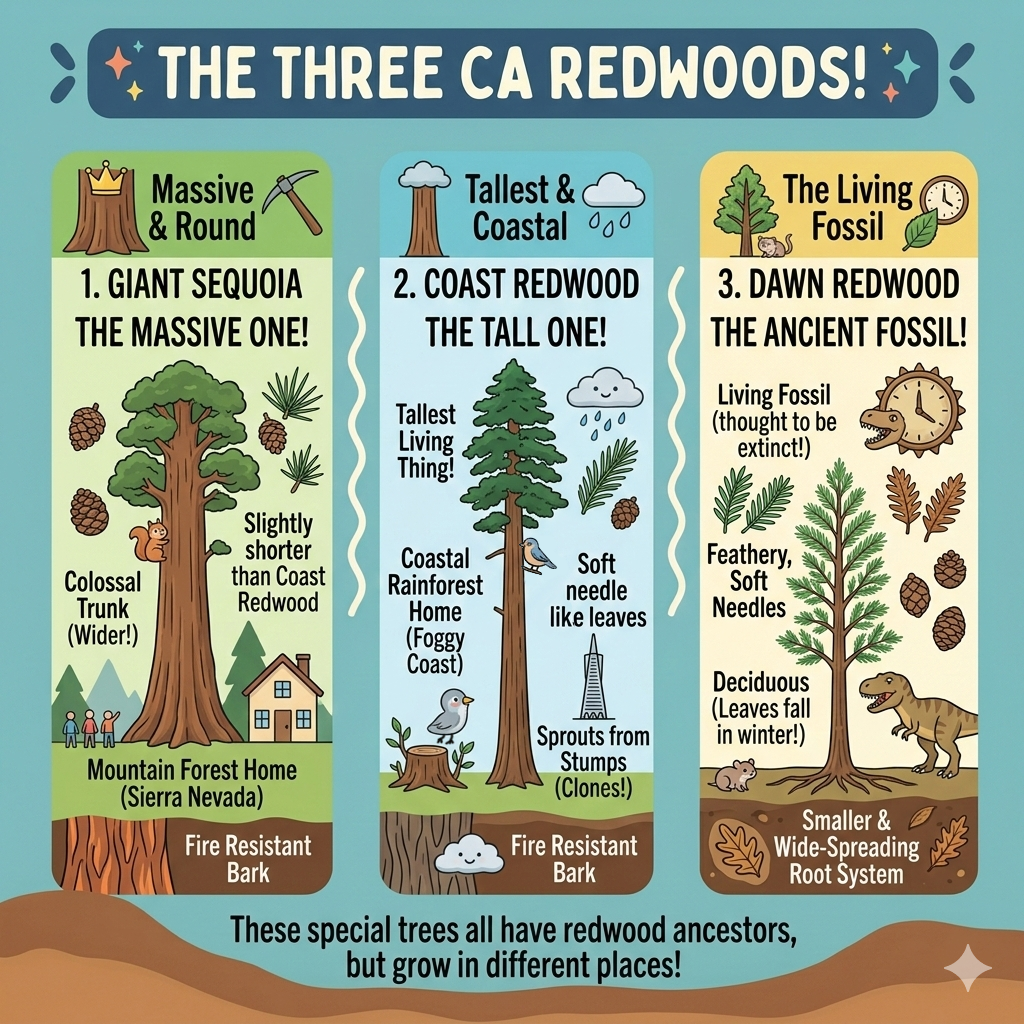
There are three main types of trees commonly associated with the name “sequoia”:
- Giant Sequoia (Sequoiadendron giganteum)
- Coast Redwood (Sequoia sempervirens)
- Dawn Redwood (Metasequoia glyptostroboides)
In California, the two most well-known are the Giant Sequoia and the Coast Redwood.
Giant Sequoias
Giant sequoias grow in the Sierra Nevada mountains of California.
They are:
- Among the largest trees on Earth by volume
- Able to grow over 250 feet (76 meters) tall
- Sometimes more than 30 feet (9 meters) wide at the base
- Capable of living over 3,000 years
The General Sherman Tree in Sequoia National Park is considered the largest tree in the world by volume.
Coast Redwoods
Coast redwoods grow along California’s northern coastline.
They are:
- The tallest trees on Earth
- Able to exceed 350 feet (107 meters) in height
- Often found in foggy coastal forests
The tallest known tree, named Hyperion, is a coast redwood.
While giant sequoias are wider and more massive, coast redwoods are taller.
Why Do Sequoias Grow So Large?
Several factors allow sequoias to grow to extraordinary sizes.
1. Climate
Coast redwoods benefit from cool, moist coastal air and frequent fog. Fog provides additional moisture during dry summers.
Giant sequoias grow in mountainous regions with snowy winters and dry summers.
2. Thick Bark
Sequoia bark can be up to 2 feet (60 cm) thick.
This thick bark protects them from:
- Fire
- Insects
- Disease
3. Fire Adaptation
Sequoias depend on periodic forest fires.
Low-intensity fires:
- Clear away smaller competing plants
- Open sequoia cones
- Release seeds into nutrient-rich soil
Without fire, new sequoia seedlings struggle to grow.
How Sequoias Reproduce
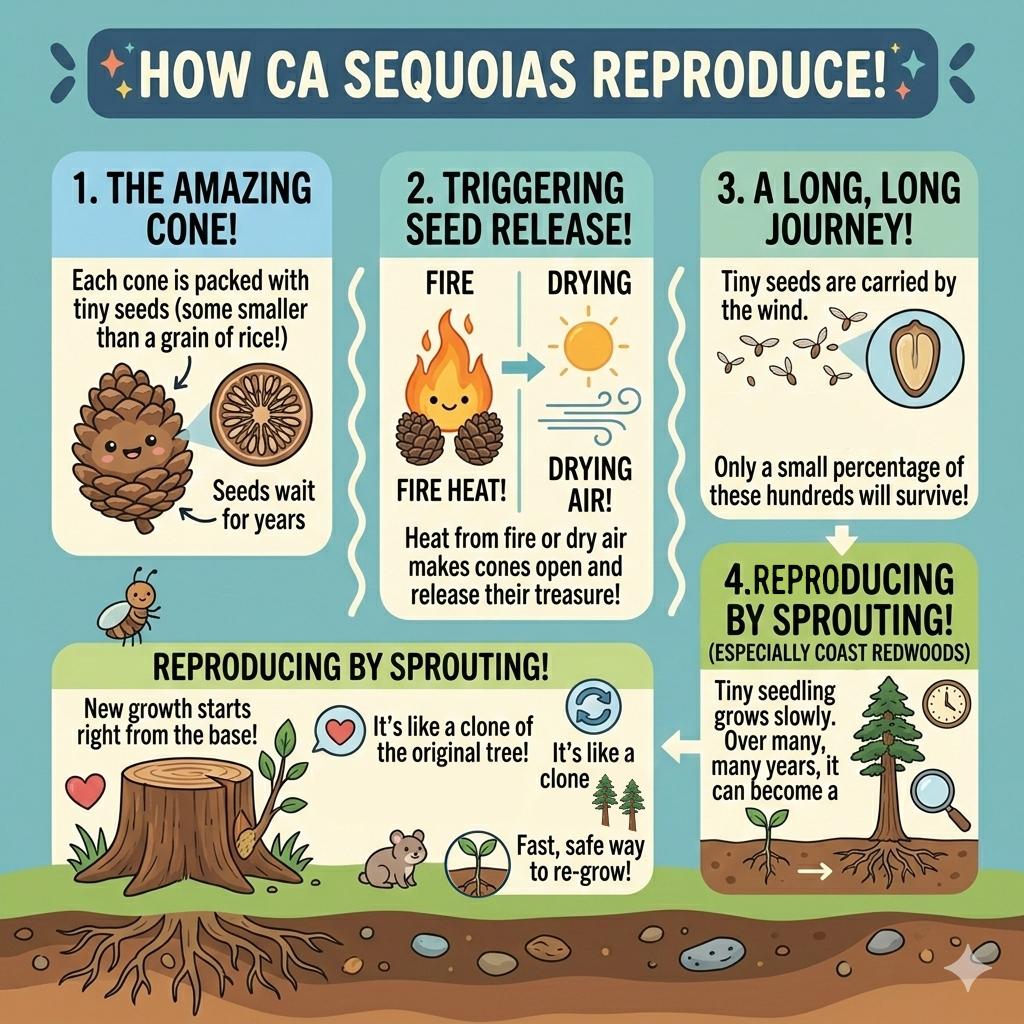
Sequoias reproduce using cones.
Each cone contains hundreds of tiny seeds.
Fire or drying conditions can cause cones to open, allowing seeds to fall.
However, only a small percentage of seeds successfully grow into mature trees.
Sequoias also reproduce by sprouting new growth from their base, especially coast redwoods.
How Old Can Sequoias Become?
Some giant sequoias are over 3,000 years old.
This means they were already growing when:
- Ancient civilizations flourished
- Major historical events unfolded
- Entire ecosystems changed around them
Their long lifespans make them valuable for studying climate history.
Scientists can examine tree rings to learn about:
- Past droughts
- Fire history
- Climate changes
Sequoias and Carbon Storage
Sequoias play an important role in climate science.
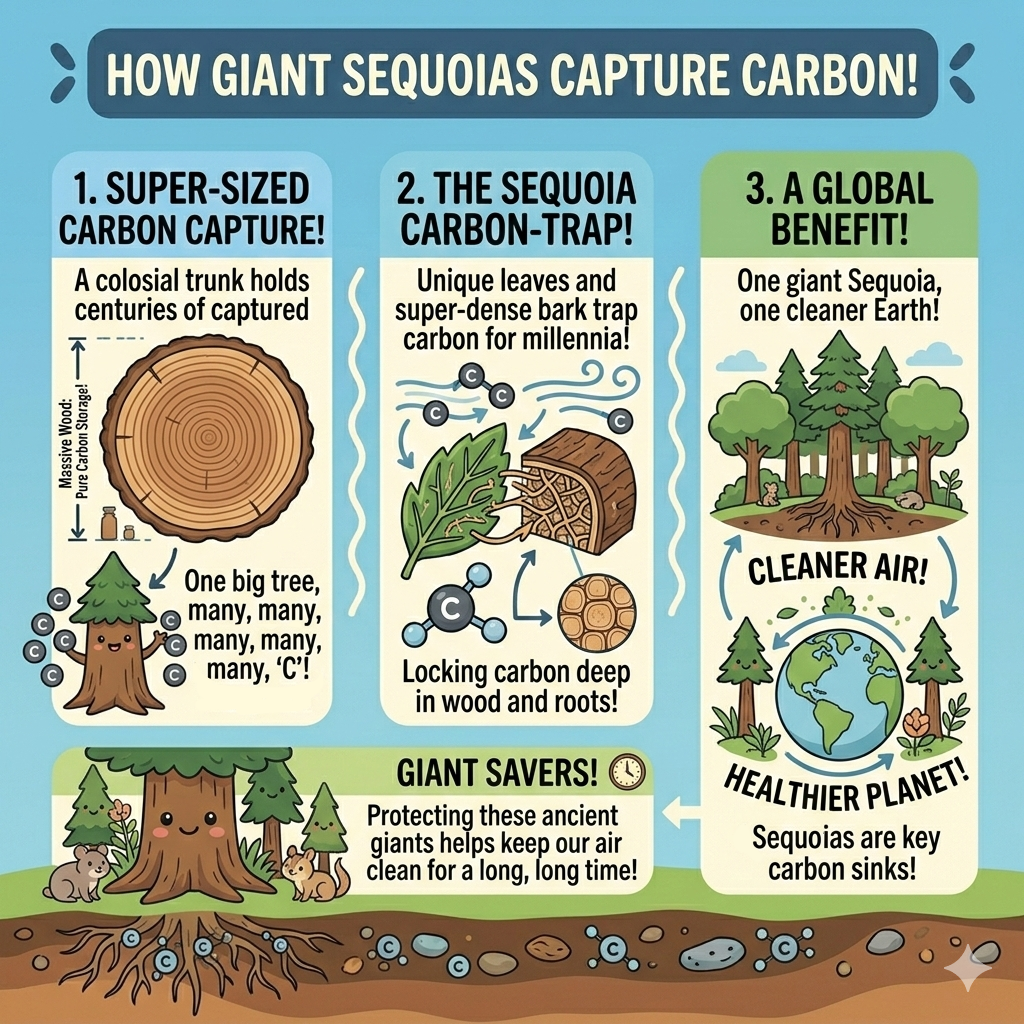
Because of their size, they store enormous amounts of carbon.
Trees absorb carbon dioxide during photosynthesis. Large trees like sequoias can store carbon for thousands of years.
This makes them important in understanding global carbon cycles.
Threats to Sequoias
Although sequoias are strong, they face modern challenges.
Climate Change
Hotter and drier conditions increase wildfire intensity.
While sequoias are adapted to fire, extremely intense fires can damage even these giants.
Habitat Loss
Historical logging reduced many redwood forests.
Today, many sequoia groves are protected in national and state parks.
Visiting Sequoia Forests
In California, visitors can see sequoias in:
- Sequoia National Park
- Kings Canyon National Park
- Redwood National and State Parks
Walking among these trees provides perspective on time, scale, and resilience.
Fun facts about California Sequoia
California’s giant sequoias are among the largest living organisms on Earth, measured by total volume. While they are not the tallest trees — that title belongs to their coastal relatives, the redwoods — giant sequoias are unmatched in sheer mass. Some individuals stand over 250 feet tall and can be more than 30 feet wide at the base. The most famous example, General Sherman Tree in Sequoia National Park, is estimated to be over 2,000 years old, meaning it was already growing during the Roman Empire.
One of the most fascinating facts about giant sequoias is that they depend on fire to survive and reproduce. Their thick, fibrous bark can grow up to two feet thick and contains tannins that make it resistant to insects and decay. This bark also protects the tree from most wildfires. In fact, periodic fires clear away competing vegetation and heat the sequoia cones, helping release seeds onto nutrient-rich soil. Without occasional fire, young sequoias struggle to take root. What may seem destructive in the short term is actually part of the forest’s long-term balance.
Despite their immense size, sequoia seeds are surprisingly small — about the size of an oat flake. A single cone can contain hundreds of seeds, yet only a few will successfully grow into mature trees. Their shallow but widespread root systems intertwine with neighboring sequoias, providing stability through shared support rather than deep taproots. Walking among these trees offers more than an impressive visual experience; it places you in the presence of living history. These forests have endured centuries of storms, droughts, and change, standing as steady reminders of resilience, interconnection, and time measured on a scale far beyond a human lifespan.
Final Reflection
California’s sequoias are more than tall trees.
They are living records of centuries past.
They survive fire, storms, and shifting climates. They grow steadily, ring by ring, year after year.
Standing beneath one encourages quiet observation.
These giants remind us that growth can be slow and steady — and that resilience often comes from deep roots.
Suggested Reading & Books
The following books recommendations are accessible to parents, educators, and thoughtful readers.
- Tweed, William – King Sequoia: The Tree That Inspired a Nation, Created Our National Park System, and Changed the Way We Think about Nature
- Kagels, R. T. – The giant sequoia & redwood trees: incredible wonders of nature
- Willard, Dwight – A Guide to the Sequoia Groves of California
- Bernacchi, Leigh – Moon Sequoia & Kings Canyon: Hiking, Camping, Waterfalls & Big Trees (Travel Guide)
- Sequoia National Park: Capturing The Serene Beauty And The Magnificent General Sherman Tree Of Sequoia National Park
Sources & Further Reading
The following trusted organizations provide accurate and educational information about sequoias and redwoods:
- National Park Service – Sequoia & Kings Canyon
https://www.nps.gov/seki/learn/nature/giant-sequoias.htm - Redwood National and State Parks
https://www.nps.gov/redw/learn/nature/redwoods.htm - U.S. Forest Service – Giant Sequoia
https://www.fs.usda.gov/managing-land/giant-sequoia - Save the Redwoods League
https://www.savetheredwoods.org
These resources are provided for educational purposes and to encourage continued exploration of forest ecosystems and conservation.