
Learning to Think About How We Think
“Think of executive functioning skills for children and teens like the roots to a mighty tree. They are the foundation for everything else in the mind”
Understanding Executive Function
The Liamming does not rush.
It pauses before crossing a stream, looks both ways before moving forward, and chooses each step with care. That quiet moment — the space between impulse and action — reflects something essential to how people think, plan, and respond.
This is where executive function lives.
Executive function is not a single skill, but a group of mental processes that help us manage our thoughts, actions, and emotions. These skills allow us to focus attention, remember instructions, organize tasks, and make decisions. They help us pause, think ahead, and respond thoughtfully rather than react automatically.
Like roots supporting a tree, executive function skills support many aspects of daily life. They are used when following multi-step directions, staying focused during conversations, managing time, and adapting to new situations. These abilities are centered in the prefrontal cortex of the brain and begin developing in early childhood, continuing to strengthen into early adulthood.
When executive function skills are still developing or need support, individuals may find it more challenging to start tasks, stay organized, regulate emotions, or keep track of time. Understanding how these skills work helps parents, educators, and learners create environments that support growth, patience, and steady development.
It is a group of mental abilities that help us:
- Plan
- Focus
- Remember instructions
- Control impulses
- Manage time
- Adjust when things change
It is sometimes called the brain’s “management system.”
Just as a calm traveler chooses the next step carefully, executive function helps us guide our thoughts and actions with intention.
What Is Executive Function?
Executive function is a set of cognitive processes that allow us to:
- Set goals
- Create plans
- Monitor progress
- Regulate emotions
- Shift attention when needed
These skills are primarily associated with the prefrontal cortex, a region located at the front of the brain.
This area develops gradually over many years — continuing into early adulthood.
That means executive function is not something we are simply born with fully formed.
It grows.
The Three Core Parts of Executive Function
Researchers often describe three central components:
1. Working Memory
Working memory allows us to hold information in mind temporarily while using it.
Examples:
- Remembering directions while walking
- Solving a math problem in your head
- Following multi-step instructions
It is the ability to keep something “active” in your thoughts long enough to use it.
2. Cognitive Flexibility
Cognitive flexibility helps us adapt when situations change.
Examples:
- Trying a different strategy when the first one doesn’t work
- Adjusting to a new schedule
- Seeing a problem from another perspective
It allows us to shift — without becoming overwhelmed.
3. Inhibitory Control
Inhibitory control helps us pause before acting.
Examples:
- Waiting your turn
- Resisting distractions
- Choosing not to interrupt
- Managing frustration
It is the skill of slowing down enough to choose your response.
Executive Function in Everyday Life
Executive function is not limited to classrooms.
It appears in daily moments:
- Packing for a trip
- Preparing a meal
- Completing a work project
- Saving money
- Managing emotions during conflict
- Following through on commitments
Even simple tasks — like getting ready in the morning — require planning, sequencing, and focus.
Without executive function, tasks feel scattered.
With it, actions feel organized.
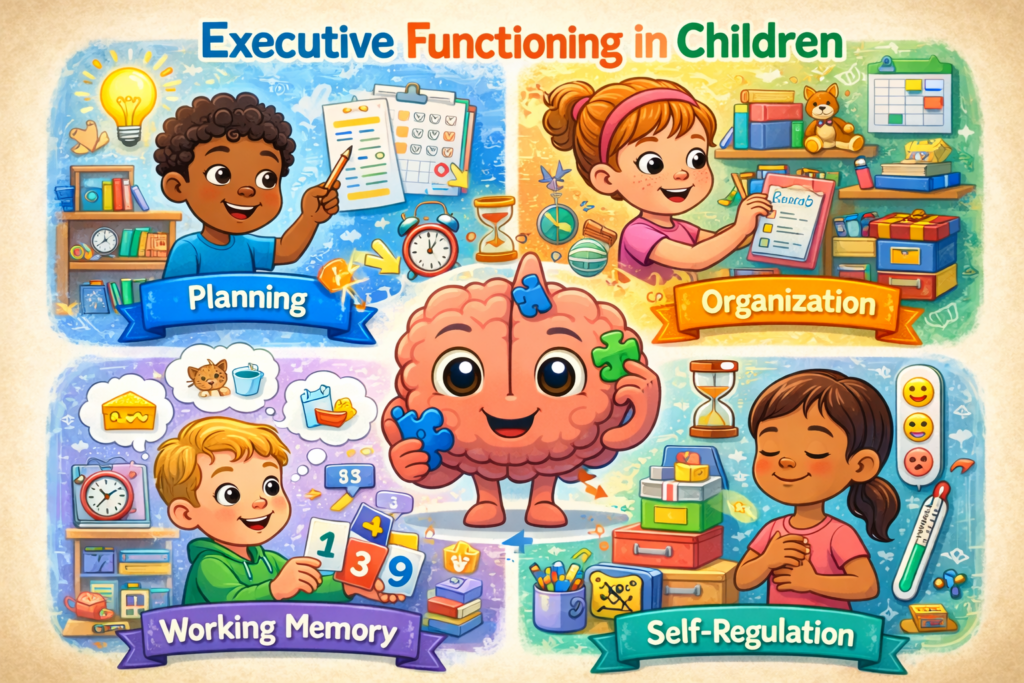
Executive Function in Children
Children are still developing these skills.
That is why you may see:
- Difficulty waiting
- Trouble following multi-step directions
- Emotional outbursts
- Forgetting instructions
- Starting tasks but not finishing
This does not mean a child lacks intelligence.
It means their executive system is still maturing.
Just as muscles grow stronger with practice, executive function strengthens with experience, modeling, and gentle guidance.
Executive Function in Adults
Executive function continues to develop into the mid-20s and can also be strengthened later in life.
Adults use executive skills when they:
- Prioritize responsibilities
- Meet deadlines
- Manage long-term goals
- Balance work and personal life
- Regulate stress
Under fatigue, stress, or overwhelm, executive function can temporarily weaken.
This is why even capable adults may struggle with organization or emotional regulation during high-pressure periods.
Calm supports clarity.
The Role of Environment
Executive function does not develop in isolation.
It is shaped by:
- Consistent routines
- Supportive relationships
- Emotional safety
- Predictable structure
- Opportunities for independent decision-making
When environments are chaotic or overwhelming, executive skills are harder to access.
When environments are calm and structured, executive function has space to grow.
This aligns closely with the Liamming philosophy:
Curiosity grows best in stillness 01 Home.
So does self-regulation.
How to Support Executive Function (Gently)
Rather than forcing performance, executive skills respond best to steady support.
Here are calm strategies:
For Children
- Break tasks into smaller steps
- Use visual schedules
- Practice waiting games
- Model problem-solving out loud
- Encourage reflection: “What could we try next?”
For Adults
- Write down priorities
- Limit multitasking
- Create consistent routines
- Pause before reacting
- Build margin into schedules
Executive function grows through repetition — not pressure.
Executive Function and Emotional Regulation
One of the most important aspects of executive function is emotional control.
When emotions rise quickly, executive control can shrink.
This is why pausing matters.
The space between feeling and action is where growth happens.
Just like the Liamming standing beside a river before crossing — observing the current, choosing a steady path — executive function helps us move forward thoughtfully rather than react impulsively.
Why Executive Function Matters
Executive function influences:
- Academic success
- Workplace performance
- Social relationships
- Long-term goal achievement
- Emotional well-being
It allows knowledge to be applied effectively.
Intelligence alone is not enough.
Planning, flexibility, and self-control transform knowledge into action.
More Details on Executive Functioning for you
Executive functioning refers to a set of mental skills that help us plan, focus, remember instructions, manage time, and regulate behavior. These skills act like the brain’s management system. They allow us to set goals, break tasks into steps, resist distractions, and adjust when something does not go as expected. Rather than being a single ability, executive functioning includes working memory (holding information in mind), cognitive flexibility (shifting perspectives or strategies), and inhibitory control (pausing before acting).
For children, executive functioning develops gradually and continues strengthening into early adulthood. Young learners rely heavily on external structure — routines, visual schedules, clear instructions, and gentle reminders. When a child forgets homework, struggles to transition between activities, or becomes easily distracted, it is often not a lack of intelligence or effort. It may reflect skills that are still forming. Supportive strategies such as breaking tasks into smaller steps, using checklists, modeling planning out loud, and practicing simple time-management routines help build these abilities over time.
As children grow into teens, executive functioning becomes even more important. Academic workloads increase, long-term projects require planning, and social dynamics demand flexibility and impulse control. Teaching teens how to use calendars, prioritize tasks, estimate time realistically, and reflect on what strategies work best empowers them to become more independent. Importantly, executive functioning improves with practice, patience, and consistency. It is less about perfection and more about gradual strengthening — learning to pause, think ahead, and choose intentionally rather than react automatically. When nurtured thoughtfully, these skills support confidence, resilience, and lifelong learning.
A Calm Reflection
Executive function is not about perfection.
It is about direction.
It is the quiet ability to pause, plan, and proceed.
In a fast-moving world, these skills can feel strained.
But they can also be strengthened.
The Liamming teaches that progress does not require urgency.
It requires attention.
And executive function is attention in motion.
Sources & Further Reading
1. Center on the Developing Child at Harvard University
Harvard University provides foundational research summaries on executive function development in children, including working memory, cognitive flexibility, and inhibitory control.
https://developingchild.harvard.edu/science/key-concepts/executive-function/
2. Diamond, A. (2013). Executive Functions. Annual Review of Psychology, 64, 135–168.
A comprehensive academic review defining executive functions and summarizing decades of research. Widely cited in developmental psychology and neuroscience.
https://doi.org/10.1146/annurev-psych-113011-143750
3. Miyake, A., et al. (2000). The Unity and Diversity of Executive Functions. Cognitive Psychology, 41(1), 49–100.
Seminal research paper identifying three core components: working memory, cognitive flexibility, and inhibitory control.
https://doi.org/10.1006/cogp.1999.0734
4. Best, J. R., & Miller, P. H. (2010). A Developmental Perspective on Executive Function. Child Development, 81(6), 1641–1660.
Explains how executive function develops from childhood through adolescence.
https://doi.org/10.1111/j.1467-8624.2010.01499.x
5. National Institute of Mental Health (NIMH)
Overview of brain regions involved in executive functioning, including the prefrontal cortex.
https://www.nimh.nih.gov
6. American Psychological Association (APA) Dictionary of Psychology
Clear definition of executive function and its components.
https://dictionary.apa.org/executive-function
7. Zelazo, P. D., & Carlson, S. M. (2012). Hot and Cool Executive Function in Childhood and Adolescence. Child Development Perspectives, 6(4), 354–360.
Discusses emotional regulation (“hot” EF) vs. cognitive regulation (“cool” EF).
https://doi.org/10.1111/j.1750-8606.2012.00246.x