
How Humans Grow Across Time
“Children have real understanding only of that which they invent themselves” – Jean Piaget
Stages of Human Development
The Liamming does not bloom all at once.
In spring, it wakes slowly.
In summer, it explores widely.
In autumn, it reflects.
In winter, it rests.
Its growth follows seasons — gradual, changing, and continuous.
Human development unfolds in much the same way.
We do not become who we are in a single moment. Instead, growth happens over time, through a series of stages that build on one another. From early childhood to adolescence and into adulthood, each stage brings new abilities, challenges, and ways of understanding the world.
These stages are shaped by both biological development and life experiences. As the brain grows and changes, so do our abilities to think, regulate emotions, form relationships, and make decisions. Each phase has its own pace, and progress is not always linear — there are periods of rapid growth as well as times of rest and reflection.
Understanding development as a gradual process helps us approach learning with patience. Just as seasons cannot be rushed, growth cannot be forced. With time, support, and experience, each stage contributes to a fuller and more balanced development over the course of life.
What Are Developmental Stages?
Developmental stages describe the predictable patterns of growth that unfold from infancy through adolescence, shaped by both biology and environment. While every child develops at their own pace, research in psychology and neuroscience shows that certain milestones tend to emerge in sequence. For example, infants first develop basic motor control — lifting their heads, rolling over, sitting — before progressing to crawling and walking. Similarly, language develops from babbling to single words to full sentences, reflecting rapid neural growth in the brain’s language centers during early childhood.
Cognitive development also moves through recognizable stages. Young children tend to think concretely, understanding what they can see and experience directly. As they grow, logical reasoning strengthens, and by adolescence many begin developing abstract thinking — the ability to consider hypothetical ideas, moral questions, and multiple perspectives at once. This shift is supported by changes in the prefrontal cortex, the part of the brain responsible for planning, impulse control, and long-term decision-making, which continues maturing into the mid-20s.
Emotional and social development evolve alongside physical and cognitive changes. Toddlers begin learning emotional regulation with adult support, school-age children develop deeper friendships and a sense of competence, and teens explore identity and independence. One interesting fact is that development is not strictly linear — growth often occurs in bursts, followed by consolidation periods. Temporary regressions can happen before major leaps forward. Understanding developmental stages helps adults respond with patience and realistic expectations, recognizing that each phase builds upon the one before it. Growth is a process shaped by time, experience, and connection — unfolding gradually rather than all at once.
Developmental stages are predictable patterns of growth that occur over time.
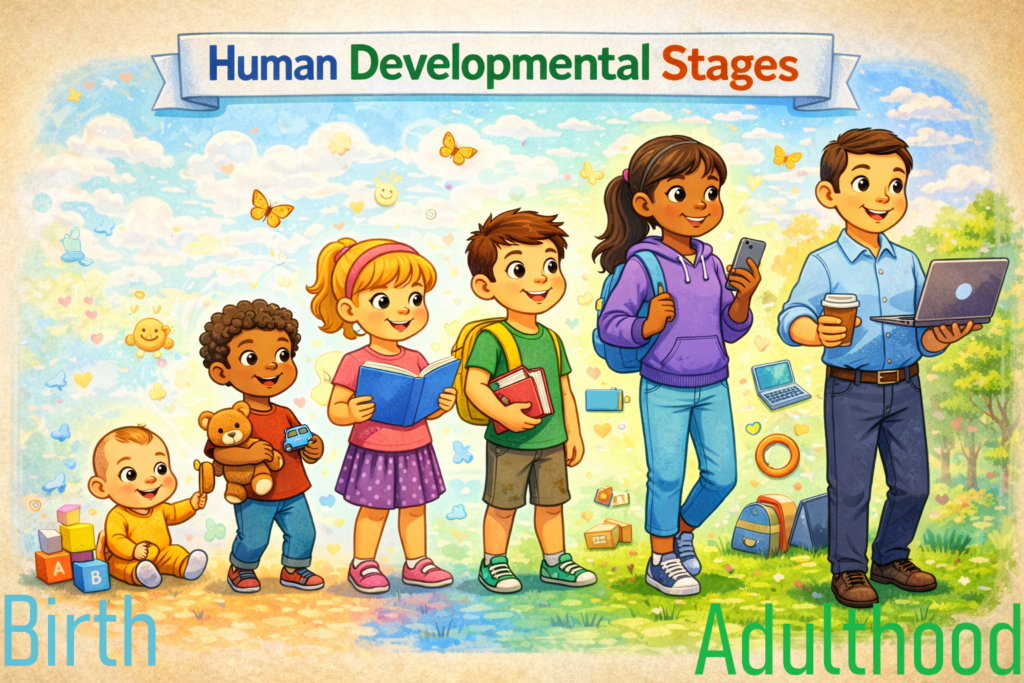
They describe changes in:
- Physical ability
- Cognitive skill
- Emotional regulation
- Social understanding
- Identity formation
These stages do not represent rigid deadlines.
They represent general progressions.
Every person moves at their own pace.
But the overall sequence tends to follow similar pathways.
Early Childhood (Birth to Age 5)
The Foundations
Early childhood is a period of rapid growth.
The brain develops faster during these years than at any other time in life. Also, for parents, please know that your baby is listening and taking in the world even before they are born. Read to them, talk to them, and narrate your world to them.
Children learn through:
- Sensory exploration
- Movement
- Imitation
- Attachment relationships
Key developments include:
- Language acquisition
- Motor coordination
- Emotional regulation beginnings
- Basic trust and security
Attachment relationships during this stage shape how children understand safety.
Exploration grows from secure connection.
Curiosity grows best in stillness 01 Home.
Middle Childhood (Ages 6–11)
Skill and Structure
During middle childhood, thinking becomes more logical and organized. They are now little scientists that are curious about their world around them. They want to touch and feel and see how things work.
Children develop:
- Improved attention
- Growing executive function
- Academic skills
- Peer relationships
- Moral reasoning
They begin comparing themselves to others.
Success and failure feel more visible.
This stage benefits from:
- Encouragement
- Structured routines
- Balanced challenge
- Support for persistence
Growth mindset becomes especially important here.
Mistakes are common — and powerful teachers.
Adolescence (Ages 12–18)
Identity and Independence
Adolescence brings significant neurological and emotional change. Don’t buy into the moody teen stereotypes, they are now facing changes about themselves, their social life, and their relationship with the world and need you.
The brain continues developing — especially in areas related to:
- Impulse control
- Planning
- Emotional regulation
- Risk evaluation
At the same time, identity becomes central.
Adolescents ask:
- Who am I?
- What do I believe?
- Where do I belong?
Peer relationships gain importance.
Independence expands.
This stage often includes:
- Emotional intensity
- Experimentation
- Boundary testing
- Rapid social learning
Supportive relationships remain crucial.
Even when adolescents appear distant, connection still matters deeply.
Early Adulthood (Ages 18–30)
Direction and Stability
Early adulthood often focuses on:
- Career development
- Higher education
- Romantic partnerships
- Increased independence
- Financial responsibility
The prefrontal cortex — responsible for executive function — continues maturing into the mid-20s.
Decision-making capacity strengthens.
Identity solidifies further.
But growth remains ongoing.
This stage often involves balancing ambition with stability.
Adulthood (30+)
Integration and Adaptation
Development does not stop after youth.
Adults continue growing through:
- Career shifts
- Relationships
- Parenthood
- Loss and grief
- Reflection
- Life transitions
Emotional regulation may strengthen.
Perspective deepens.
Patterns learned earlier may be reconsidered.
Neuroplasticity remains present.
Change is always possible.
Growth becomes less visible — but not less real.
Development Is Not Linear
Development does not move in a straight line.
People may:
- Advance quickly in one area
- Struggle in another
- Revisit earlier challenges
- Grow through unexpected experiences
Stress, trauma, support systems, and environment all influence development.
There is no universal timetable for maturity.
There are patterns — but not rigid rules.
The Liamming moves forward steadily — but not in perfect lines.
Growth curves.
The Role of Environment
Every stage of development is shaped by environment.
Supportive environments provide:
- Emotional safety
- Predictability
- Encouragement
- Healthy boundaries
- Opportunity for exploration
Overwhelming environments can slow development or shift its path.
But growth can resume when safety returns.
Development is resilient.
Individual Differences
Temperament influences development.
Some children are naturally cautious.
Some are highly energetic.
Some are emotionally sensitive.
Some are socially bold.
These differences are not problems.
They are variations.
Healthy development does not mean sameness.
It means progress relative to individual starting points.
Why Understanding Development Matters
When we understand developmental stages, we gain:
- Patience
- Perspective
- Realistic expectations
- Compassion
We stop asking:
“Why aren’t they acting older?”
And instead ask:
“What stage are they in?”
Understanding reduces frustration.
It increases empathy.
A Calm Reflection
The Liamming does not hurry spring into summer.
It allows the season to unfold.
Humans grow the same way.
Infancy becomes childhood.
Childhood becomes adolescence.
Adolescence becomes adulthood.
Each stage brings its own challenges.
Each stage brings its own strengths.
Growth is not a race.
It is a rhythm.
And when we understand the rhythm, we move with it — not against it.
Sources & Further Reading
Foundational Developmental Theories
1. Piaget, J. (1952). The Origins of Intelligence in Children.
Introduced the stages of cognitive development (sensorimotor, preoperational, concrete operational, formal operational).
2. Erikson, E. H. (1950). Childhood and Society.
Proposed the eight stages of psychosocial development across the lifespan (trust vs. mistrust through integrity vs. despair).
3. Vygotsky, L. S. (1978). Mind in Society: The Development of Higher Psychological Processes.
Emphasized the role of social interaction and environment in cognitive development.
Brain Development & Adolescence
4. Steinberg, L. (2008).
A social neuroscience perspective on adolescent risk-taking. Developmental Review, 28(1), 78–106.
Explains neurological changes during adolescence, including prefrontal cortex development.
5. Giedd, J. N. (2004).
Structural magnetic resonance imaging of the adolescent brain. Annals of the New York Academy of Sciences, 1021, 77–85.
Demonstrates that brain maturation continues into early adulthood.
6. Casey, B. J., Jones, R. M., & Hare, T. A. (2008).
The adolescent brain. Annals of the New York Academy of Sciences, 1124, 111–126.
Research on emotional regulation and executive function development.
Early Brain Architecture & Environment
7. Center on the Developing Child at Harvard University
Explains how early experiences shape brain architecture and long-term development.
https://developingchild.harvard.edu
8. Shonkoff, J. P., & Phillips, D. A. (Eds.). (2000). From Neurons to Neighborhoods: The Science of Early Childhood Development.
Comprehensive review of how environment influences early development.
Lifespan Development
9. Baltes, P. B. (1987).
Theoretical propositions of life-span developmental psychology. Developmental Psychology, 23(5), 611–626.
Introduced the idea that development continues throughout the lifespan.
10. Santrock, J. W. (Various editions). Life-Span Development.
Widely used academic overview of developmental stages from infancy through late adulthood.
Temperament & Individual Differences
11. Rothbart, M. K. (2011).
Becoming Who We Are: Temperament and Personality in Development.
Explores how temperament influences developmental pathways.