
Insects are everywhere.
“The smallest creatures often hold the key to the grandest mysteries of our ecosystems.” – R. Carson
They crawl beneath leaves, hover near flowers, and move quietly through forests, fields, and gardens. Some sing from trees at night, while others work unseen beneath the soil. Though small, insects play essential roles in keeping ecosystems functioning and balanced.
Insects are among the most diverse and widespread groups of living organisms on Earth. They help pollinate plants, break down organic material, support food chains, and contribute to the health of ecosystems in ways that are often overlooked. What may seem like a simple movement of a butterfly or a line of ants is often part of a much larger system at work.
When the Liamming travels, it often notices insects first — not because they are loud, but because they are constantly active. A butterfly drifting over a trail, a line of ants crossing a path, or a beetle reflecting sunlight can turn an ordinary moment into a closer look at life and how it functions.
This page offers a calm introduction to insects and what are often called “bugs,” exploring what they are, how they live, and why they matter. By observing these small creatures more closely, we begin to understand how even the smallest forms of life contribute to the balance of the natural world.
Are “Bugs” and Insects the Same Thing?
People often use the word bug to mean any tiny crawling creature.
In science, the word insect has a clear meaning.
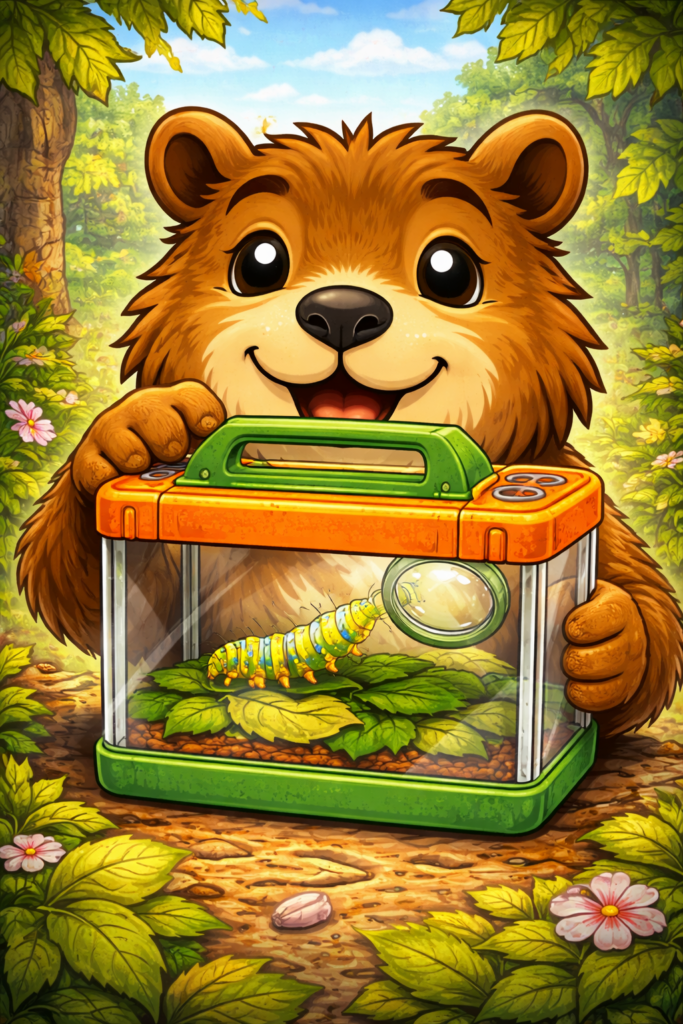
Insects are animals that usually have:
- 6 legs
- 3 main body parts (head, thorax, abdomen)
- 2 antennae
- Often wings (but not always)
Examples of insects include:
- Butterflies and moths
- Bees and wasps
- Ants and termites
- Beetles
- Flies
- Dragonflies
- Grasshoppers
“True bugs” are a special group of insects
In biology, “true bugs” are insects in a specific group called Hemiptera (like stink bugs and aphids). Many true bugs have a mouthpart shaped like a straw for piercing and sucking plant juices.
So:
- All true bugs are insects
- Not all insects are true bugs
Insect Body Basics
An insect’s body is built for survival.
Head
The head includes:
- Eyes
- Antennae (for sensing smell and touch)
- Mouthparts (for chewing, sipping nectar, or piercing plants)
Thorax
The thorax is the “middle section” where:
- All 6 legs attach
- Wings attach (if the insect has wings)
Abdomen
The abdomen holds:
- Digestion
- Breathing openings
- Reproductive organs
Insects have a hard outer covering called an exoskeleton.
Because of this exoskeleton, insects must molt (shed their outer layer) as they grow.
How Insects Breathe
Insects do not breathe through lungs like humans.
Many insects breathe through tiny openings along their sides called spiracles.
Air travels through small tubes inside the body.
This system works well for small animals — one reason insects are usually not huge.
Metamorphosis: How Insects Change
Some insects change dramatically as they grow.
This process is called metamorphosis.
Complete metamorphosis
These insects have four stages:
- Egg
- Larva (like a caterpillar)
- Pupa (a resting, transforming stage)
- Adult
Butterflies, beetles, flies, and bees often develop this way.
Incomplete metamorphosis
These insects grow through stages that look similar to the adult:
- Egg
- Nymph (a smaller, wingless version)
- Adult
Grasshoppers and many “true bugs” develop this way.
Metamorphosis is one of nature’s most fascinating designs — it allows insects to change their body plan to fit different stages of life.
What Insects Do for the World
Insects are not just “tiny animals.” They are essential workers in nature.
1. Pollination
Many plants depend on insects to carry pollen from flower to flower.
This helps plants produce:
- Fruits
- Seeds
- New plants
Pollination supports many foods humans eat, such as apples, berries, and squash.
2. Decomposition
Some insects help break down dead plants and animals.
This recycling returns nutrients to the soil.
Without decomposers, forests would pile up with dead material and soil would grow weaker over time.
3. Food Web Support
Insects are a major food source for:
- Birds
- Fish
- Frogs
- Lizards
- Small mammals
If insects disappear, many other animals struggle to survive.
4. Natural Pest Control
Some insects hunt other insects.
Lady beetles (ladybugs) and praying mantises, for example, can help keep plant-eating pests from exploding in number.
How Insects Sense the World
Insects experience the world differently than humans.
They may rely more on:
- Smell
- Vibration
- Light patterns
- Chemical signals
Some insects can detect smells from far away.
Others communicate using movement and touch.
Ants, for example, can leave invisible scent trails that guide other ants to food.
Insects and Night Sounds
On warm evenings, you might hear insects singing.
Crickets and some other insects create sound by rubbing body parts together.
They are not singing for humans.
They are communicating — often to attract mates or mark territory.
The steady rhythm of insect sounds can feel calming because it is repetitive and natural — like wind in trees or waves against the shore.
Night and Day Activities of Insects
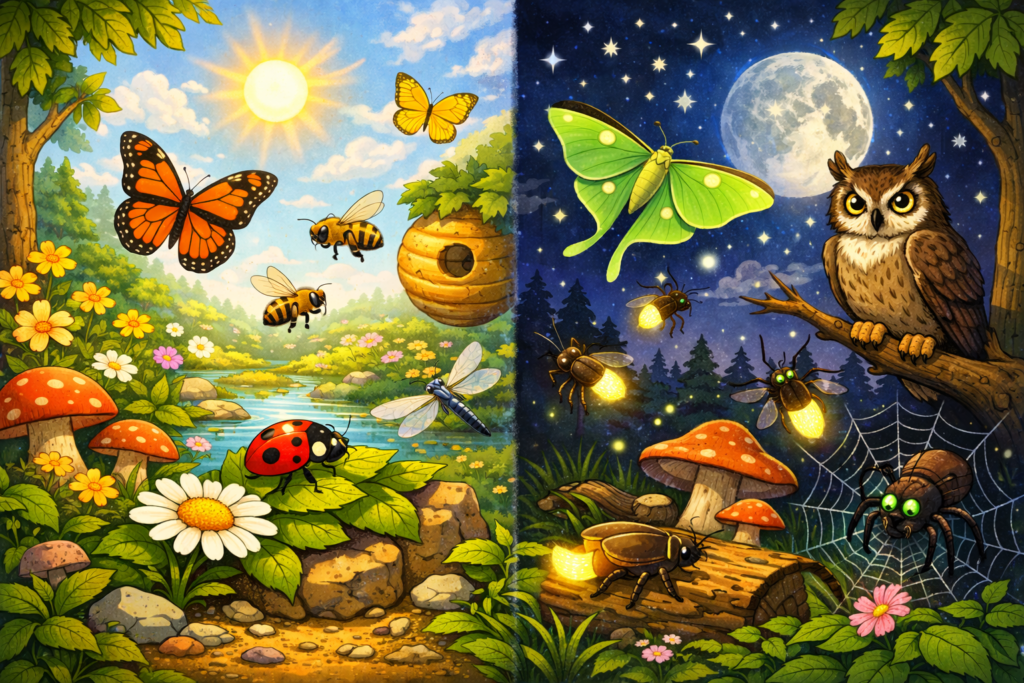
Some insects are most active during the day, while others come alive after sunset, and this timing helps them survive and thrive in different ways. Day-active insects, called diurnal insects, often rely heavily on vision. Butterflies are a classic example. Their brightly colored wings are not just beautiful — they help attract mates and sometimes warn predators that they may taste unpleasant. Bees are also daytime workers, using sunlight to navigate between flowers and their hive. In fact, many bees can see ultraviolet light, which reveals nectar guides on petals that are invisible to humans. Dragonflies, another daytime insect, are skilled aerial hunters with large compound eyes that give them nearly 360-degree vision, helping them catch mosquitoes and other small insects mid-flight.
At night, a different group of insects — known as nocturnal insects — becomes active. Moths are among the most well-known nighttime insects. While they are often less colorful than butterflies, many have intricate wing patterns designed for camouflage. Some moth species use the Moon for navigation, maintaining a steady angle to natural light sources. Artificial lights can confuse this system, which is why moths are often seen circling porch lights. Fireflies, or lightning bugs, create their own light through a chemical reaction called bioluminescence. They flash in specific patterns to attract mates, essentially sending coded light signals across the darkness. Crickets and katydids also become more noticeable at night, producing rhythmic chirping sounds by rubbing parts of their wings together — a behavior called stridulation.
Being active during the day or night reduces competition and helps insects avoid predators. Birds hunt primarily during daylight, so some insects remain hidden until dusk. Conversely, nighttime predators like bats encourage certain insects to remain active in sunlight. This division of activity creates a 24-hour cycle of ecological balance. Whether fluttering through a sunny garden or glowing softly in a summer evening field, insects fill both daylight and darkness with movement, sound, and essential ecological roles.
Insects While Traveling: Calm Observation
Insects can become part of travel in a gentle way.
“The silent conversations among insects speak volumes about the interconnectedness of all living things.” – R. Dawkins
When the Liamming explores a new place, it might notice:
- Butterflies along trails
- Beetles near lights at night
- Dragonflies hovering near water
- Ants carrying tiny crumbs with surprising strength
You don’t need to pick insects up to learn from them.
Simply watching can teach:
- Patience
- Pattern recognition
- Respect for living things
How to Observe Insects Respectfully
A calm approach keeps insects safe and makes observation easier.
- Watch from a short distance
- Avoid touching wings (they can be delicate)
- Do not step on insects or disturb nests
- Leave flowers and logs where they are
- If you use a flashlight at night, keep it gentle and brief
When we respect small creatures, we become better observers.
Fun facts about bugs and insects
Insects are the most diverse group of animals on Earth, with scientists estimating that millions of species exist — and many have yet to be discovered. They belong to a class of animals with three main body segments (head, thorax, abdomen), six legs, and often wings. While people sometimes use the word “bug” to describe all small crawling creatures, true bugs are actually a specific group within the insect world. Beetles, butterflies, ants, bees, and dragonflies are all insects, each with specialized adaptations that help them survive in different environments.
One fascinating fact about insects is their incredible strength relative to size. Ants, for example, can carry objects many times their own body weight. Bees communicate through a “waggle dance,” a movement pattern that tells other bees the direction and distance of food sources. Butterflies taste with their feet, using sensory receptors to detect suitable plants for laying eggs. Dragonflies are agile fliers capable of hovering, gliding, and even flying backward, with compound eyes that allow them to detect motion in nearly every direction.
Insects also play essential roles in ecosystems. Many species pollinate plants, including crops that humans rely on for food. Others break down dead organic material, recycling nutrients back into the soil. Some insects serve as a primary food source for birds, amphibians, and other animals, forming a critical link in the food chain. Despite their small size, insects influence global systems in significant ways. Observing them closely — whether watching a ladybug crawl across a leaf or listening to crickets at dusk — reveals complex behaviors and delicate structures that are easy to overlook at first glance.
Final Reflection
Insects are easy to overlook.
But they are builders, pollinators, recyclers, and quiet helpers.
They hold ecosystems together in ways that are often invisible until you stop and look.
For the Liamming, insects are a reminder that learning does not require a giant museum or a huge landscape.
Sometimes learning is as small as a beetle crossing a path.
And sometimes the smallest lives carry the biggest lessons.
Suggested Reading & Books
The following books recommendations are accessible to parents, educators, and thoughtful readers.
- Everything You Need to Know About Bugs
- The Fascinating Bug Book for Kids: 500 Startling Facts! (Fascinating Facts)
- Bug Explorers! A Bug Book for Kids: Outdoor Activities, Insect Facts, and Stickers
- Bug Catcher for Kids Explorer Bug Catching Kit,Magnifying Glass, Tweezers, Whistle & Compass, Learning Guide, Insect Habitat, Outdoor Toys(3 Year +)
Sources & Further Reading
The following trusted resources offer beginner-friendly information about insects, life cycles, and ecosystems:
- Smithsonian National Museum of Natural History – Insects & Entomology (Education and Topics) https://naturalhistory.si.edu/education
- University of Florida IFAS – “Featured Creatures” (Excellent insect facts and identification) https://entnemdept.ufl.edu/creatures/
- U.S. Forest Service – Pollinators and Pollination (Background and why it matters) https://www.fs.usda.gov/wildflowers/pollinators/
- National Geographic Education – Insects (Student-friendly overviews) https://www.nationalgeographic.org/
- Encyclopedia Britannica – Insect (Reference overview) https://www.britannica.com/animal/insect
These resources are provided for educational purposes and to encourage safe, curious exploration of the natural world.