

A Calm Approach to Helping Children Learn
Growing Curiosity with Patience, Understanding, and Care
Children are not empty containers waiting to be filled.
They are growing minds.
They are observers.
They are pattern-noticers.
They are question-askers.
From the very beginning of life, children are learning — long before school, long before worksheets, long before grades. They learn by watching faces. By listening to voices. By touching, stacking, falling, trying again.
Learning is not something that begins in a classroom.
It begins in relationship.
The Power of Calm
Modern life moves quickly. Schedules are full. Screens are bright. Expectations can feel heavy.
But child development research shows something important:
Children learn best when they feel safe.
When a child feels calm, their brain is open to curiosity.
When a child feels rushed or anxious, their brain shifts into protection mode.
A calm environment is not about silence or strict control.
It is about emotional steadiness.
A steady voice.
Predictable routines.
Patience when mistakes happen.
Calm does not slow learning.
Calm supports learning.
Understanding Development
Children are not “mini adults.”
Their brains are still building connections. Their emotional regulation systems are still forming. Their attention spans grow gradually over time.
Developmental psychology teaches us that:
- Young children learn through play.
- Repetition builds neural pathways.
- Mistakes are necessary for growth.
- Emotional security strengthens cognitive ability.
What may look like distraction is often exploration.
What may look like stubbornness is often a developing sense of independence.
What may look like endless “why” questions is the foundation of scientific thinking.
Growth takes time.
Just as trees do not rush to reach the sky, children do not rush to reach maturity.
Learning Through Connection
Children learn most deeply from people, not pressure.
A parent reading slowly beside a child.
A teacher kneeling down to listen.
A caregiver responding with empathy instead of frustration.
Connection builds trust.
Trust builds confidence.
Confidence builds curiosity.
And curiosity builds lifelong learning.
For Children
If you are a child reading this:
It is okay to take your time.
It is okay to ask questions.
It is okay to try again.
Your brain is growing every day — even when you cannot see it.
For Parents, Teachers, and Caregivers
If you are guiding a child:
Your calm matters.
Your patience matters.
Your belief in their ability matters.
Children do not need perfection.
They need steady support.
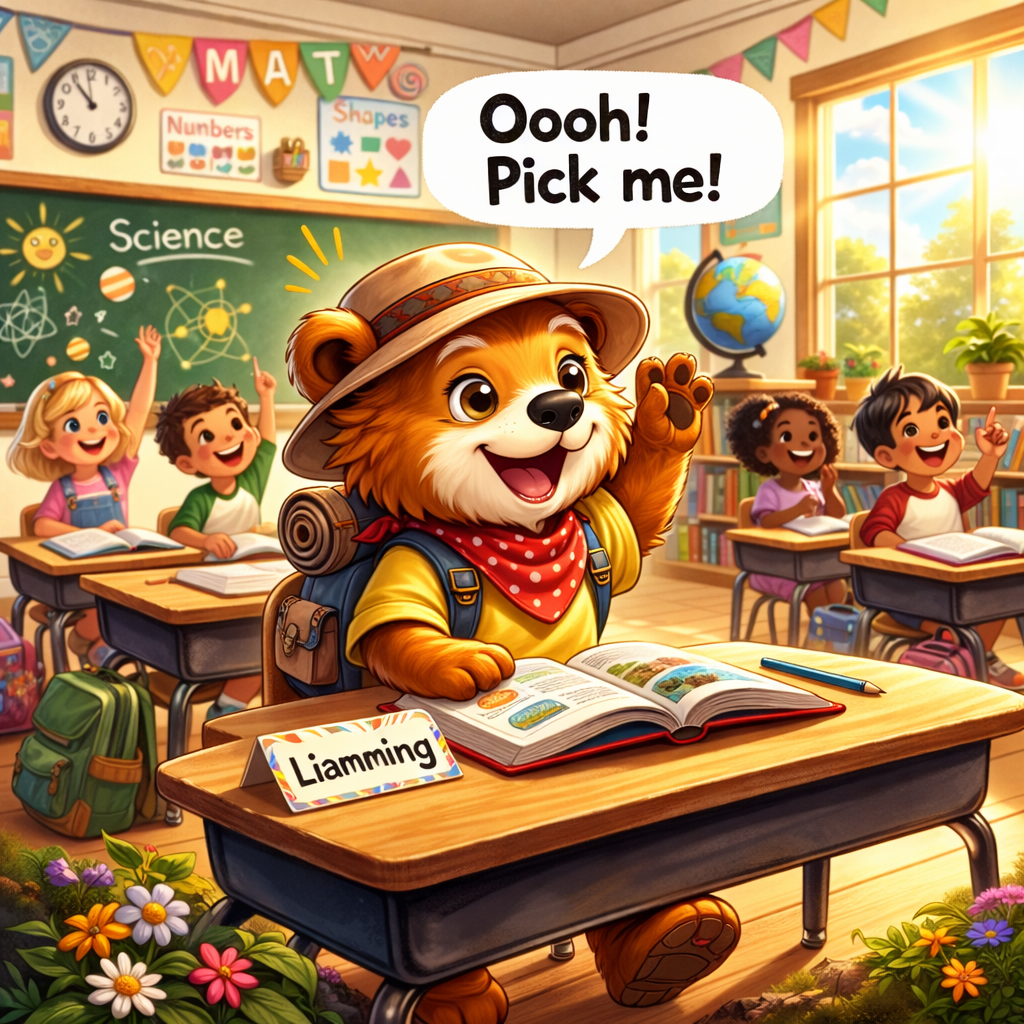
The Spirit of the Liamming
The Liamming never rushes into knowledge.
It watches the river and wonders how it flows.
It sits beside a turtle and notices its patience.
It understands that learning is not a race.
It is a journey.
A calm approach to child development honors something simple but powerful:
Curiosity grows best in safety.
Growth happens best in connection.
Understanding develops steadily, not suddenly.
We do not need to hurry children toward the future.
We can walk beside them — calmly, attentively, and with kindness.
And in doing so, we often learn alongside them.
A Calm Approach to Child Development
Understanding How Children Grow, Learn, and Thrive
This section explores how children develop — emotionally, cognitively, socially, and physically — and how a calm environment supports that growth.
Each area builds on a simple belief:
Children grow best when they feel safe, seen, and supported.
1. Emotional Regulation
Helping Children Understand and Manage Big Feelings
Children are not born knowing how to manage emotions.
They are born feeling them.
Strongly.
A toddler’s frustration, a preschooler’s tears, a school-age child’s anger — these are not signs of failure. They are signs of development in progress.
Emotional regulation is the ability to:
- Notice a feeling
- Name it
- Tolerate it
- Recover from it
But this skill develops slowly. The part of the brain responsible for regulation — the prefrontal cortex — continues developing well into early adulthood.
Children borrow calm from adults.
When caregivers respond with steady voices and predictable boundaries, children gradually internalize that steadiness.
Calm does not eliminate emotion.
It teaches children how to move through it.
Topics to ponder about:
- What happens in a child’s brain during a meltdown
- Co-regulation vs. self-regulation
- Teaching emotional vocabulary
- Why punishment doesn’t teach regulation
2. Play-Based Learning
Why Play Is the Foundation of Intelligence
To adults, play can look simple.
To a child’s brain, play is complex work.
When children build with blocks, they are learning physics and spatial reasoning.
When they role-play, they are practicing language and social negotiation.
When they run, climb, and balance, they are wiring motor coordination and confidence.
Play:
- Builds executive function
- Strengthens creativity
- Improves problem-solving
- Develops emotional resilience
Research consistently shows that young children learn more deeply through active exploration than passive instruction.
Play is not a break from learning.
Play is learning.
Topics to ponder about:
- The neuroscience of play
- Structured vs. unstructured play
- Why boredom can be beneficial
- Play across different developmental stages
3. Executive Function
Building Focus, Memory, and Self-Control Over Time
Executive function refers to mental skills that help children:
- Pay attention
- Remember instructions
- Control impulses
- Switch between tasks
- Plan and organize
These skills do not appear overnight.
They grow gradually through practice and supportive guidance.
Young children are not “bad at listening.”
They are practicing working memory.
They are not “lazy.”
They are developing sustained attention.
Executive function strengthens when:
- Expectations are age-appropriate
- Routines are predictable
- Adults model organization and calm problem-solving
Rather than demanding instant compliance, we can build capacity step by step.
Topics to ponder about:
- The developmental timeline of executive skills
- Why transitions are hard for children
- How routines build cognitive structure
- Games that strengthen working memory
4. Attachment and Secure Relationships
Why Connection Is the Root of Learning
Attachment theory teaches something powerful:
Children explore confidently when they feel securely connected.
When a caregiver responds consistently to a child’s needs, the child forms a secure base. From that base, curiosity expands.
Secure attachment leads to:
- Better emotional regulation
- Stronger social skills
- Increased resilience
- Greater academic readiness
Connection does not mean permissiveness.
It means responsiveness.
A child who feels safe does not cling forever.
They venture outward — and return — knowing someone steady is there.
Topics to ponder about:
- Secure vs. insecure attachment patterns
- Repairing after conflict
- Why connection reduces behavioral issues
- Long-term effects of early attachment
5. Growth Mindset and Mistakes
How Children Learn Through Trial and Error
Children learn by trying, failing, adjusting, and trying again.
When adults react strongly to mistakes, children may begin to avoid challenge.
When adults respond calmly and focus on effort, children learn resilience.
A calm approach to mistakes teaches:
- Errors are information
- Practice builds skill
- Intelligence is not fixed
- Effort changes outcomes
The tone around learning matters as much as the content.
Curiosity shrinks under pressure.
It expands under encouragement.
Topics to ponder about:
- The science behind growth mindset
- Praise that builds resilience
- Avoiding perfectionism
- Helping children persist through difficulty
6. Sensory Development and Environment
How Surroundings Shape Learning
Children experience the world through their senses.
Noise, light, clutter, and unpredictability can overwhelm developing nervous systems.
A calmer environment can:
- Improve attention
- Reduce emotional reactivity
- Increase independent play
- Support deeper focus
This does not mean silent rooms and rigid structure.
It means thoughtful pacing.
Predictable rhythms.
Balanced stimulation.
The nervous system influences learning more than we often realize.
Topics to ponder about:
- Sensory overload and behavior
- Creating calming spaces at home or school
- Outdoor environments and brain development
- The role of movement in focus
7. Developmental Stages
Understanding What Is Typical — and When
Children develop in stages.
Cognitive, emotional, and social abilities emerge gradually and sometimes unevenly.
Understanding typical development prevents unrealistic expectations.
For example:
- Toddlers are wired for autonomy and boundary-testing
- Preschoolers think concretely and struggle with abstract logic
- School-age children begin developing moral reasoning
- Adolescents experience rapid brain restructuring
When we align expectations with developmental reality, conflict decreases and cooperation increases.
Topics to ponder about:
- Milestones from birth through adolescence
- Brain development timelines
- Common misconceptions about behavior
- Supporting transitions between stages
Source & Further Reading
The following research and educational resources support the principles discussed in this section, including emotional development, play-based learning, executive function, attachment, and calm environments.
Recommended Books for Further Reading
• Siegel, Daniel J. & Bryson, Tina Payne — The Whole-Brain Child
• Shonkoff, Jack P. & Phillips, Deborah A. — From Neurons to Neighborhoods
• Diamond, Adele — Research on Executive Function & Executive Function Skills in the Classroom
• Dweck, Carol — Mindset
• Panksepp, Jaak — Affective Neuroscience
Emotional Development & Regulation
• Harvard Center on the Developing Child — Children’s Emotional Development Is Built into the Architecture of Their Brains
https://developingchild.harvard.edu/resources/childrens-emotional-development-is-built-into-the-architecture-of-their-brains/
• Emotion Regulation & Child Development (Child Encyclopedia)
https://www.child-encyclopedia.com/emotions/according-experts/emotion-regulation
• National Scientific Council on the Developing Child — Working Papers
https://developingchild.harvard.edu/resources/working-papers/
Play & Learning
• American Academy of Pediatrics — The Power of Play: A Pediatric Role in Enhancing Development
https://publications.aap.org/pediatrics/article/142/3/e20182058/38649/The-Power-of-Play-A-Pediatric-Role-in-Enhancing
• Harvard Center on the Developing Child — Play & Brain Development Resources
https://developingchild.harvard.edu/science/key-concepts/play/
• LEGO Foundation — Research on Learning Through Play
https://learningthroughplay.com/explore-the-research
Executive Function & Self-Regulation
• Harvard Center on the Developing Child — Executive Function & Self-Regulation
https://developingchild.harvard.edu/science/key-concepts/executive-function/
• Enhancing and Practicing Executive Function Skills with Children (PDF Guide)
https://developingchild.harvard.edu/resources/enhancing-and-practicing-executive-function-skills-with-children-from-infancy-to-adolescence/
• Center on the Developing Child — InBrief: Executive Function
https://developingchild.harvard.edu/resources/inbrief-executive-function/
Attachment & Secure Relationships
• Attachment Theory (Child Encyclopedia Overview)
https://www.child-encyclopedia.com/attachment
• The Attachment & Biobehavioral Catch-up Program (evidence-based overview)
https://abcintervention.org/
• American Psychological Association — Attachment Research Overview
https://www.apa.org/topics/attachment
Growth Mindset & Learning from Mistakes
• Carol Dweck — Growth Mindset Overview
https://www.mindsetworks.com/science/
• Stanford PERTS — Research on Motivation & Learning
https://perts.net/research/
Environment & Sensory Development
• Harvard Center on the Developing Child — Toxic Stress & Brain Development
https://developingchild.harvard.edu/science/key-concepts/toxic-stress/
• CDC — Child Development Basics
https://www.cdc.gov/ncbddd/childdevelopment/facts.html