
What the Ocean Is, How It Works, and the Life Within It
The Liamming often pauses at the edge of the sea — not only because it is beautiful, but because the ocean invites curiosity. It stretches beyond the horizon, moving constantly, yet often appearing calm and steady.
Standing by the ocean raises natural questions. Why do waves return again and again? Why is seawater salty? How can the ocean feel peaceful one moment and powerful the next? And what kinds of life exist beneath the surface, far beyond what we can easily see?
The ocean is more than a vast body of water. It is a dynamic system that shapes climate, supports ecosystems, and connects environments across the entire planet. Its movement, chemistry, and depth create conditions that allow a remarkable diversity of life to exist — from microscopic organisms to the largest animals on Earth.
This page offers a calm, accessible introduction to the ocean and sea life for both children and adults. Together, we will explore what the ocean is, how it moves, how it supports life, and why it matters — even to those who live far from the coast.
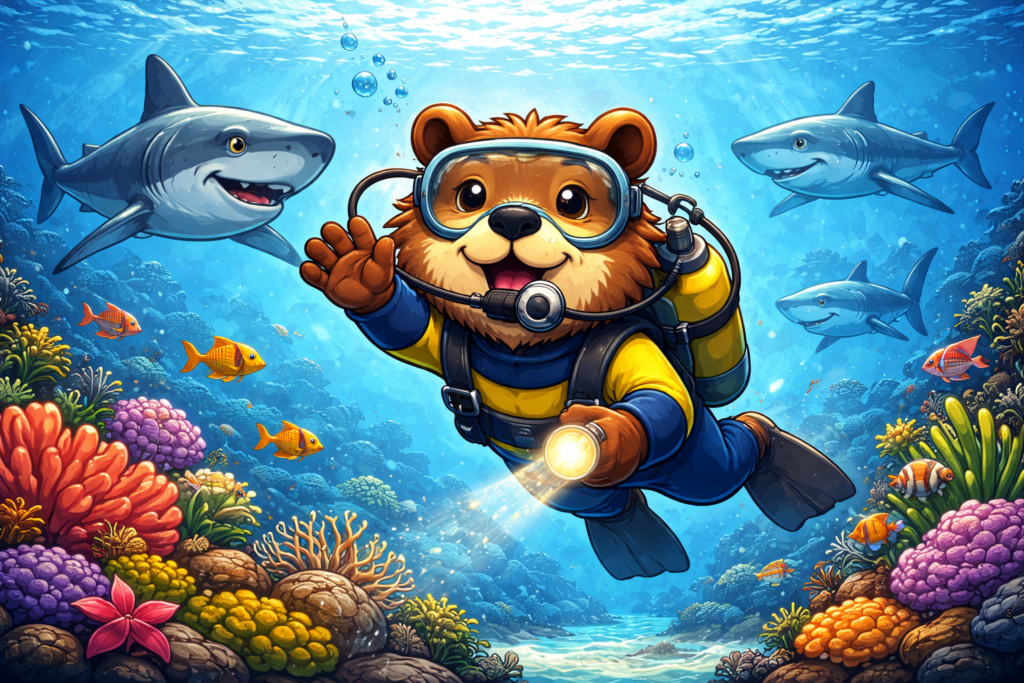
What Is the Ocean?
The ocean is one connected body of saltwater that covers about 70% of Earth’s surface. Even though we name different oceans (Pacific, Atlantic, Indian, Southern, Arctic), they are all connected.
The ocean is not just “water.” It is a living system that:
- shapes weather and climate
- moves heat around the planet
- supports a huge variety of animals and plants
- provides food for millions of people
- helps produce much of the oxygen we breathe
When you stand on a beach, you’re looking at something enormous — but also something interconnected with forests, clouds, rivers, and even the air above your home.
Why Is Ocean Water Salty?
A calm and simple way to think about saltiness is this:
- Rain falls on land.
- Water flows over rocks and soil.
- Tiny amounts of minerals (including salts) dissolve into the water.
- Rivers carry those minerals to the sea.
- Water evaporates from the ocean — but salt stays behind.
Over a very long time, this process helps make the ocean salty.
Saltiness in ocean water is called salinity, and it affects:
- which creatures can live in certain areas
- how water moves and mixes
- the density of seawater (how “heavy” it is)
The Ocean Is Always Moving
Even when the sea looks still, it is moving.
Waves
Waves are usually caused by wind pushing across the surface. The wind transfers energy into the water, forming rolling patterns.
Important note:
A wave is mostly energy moving through water, not a “pile” of water traveling forward forever. The water particles mostly move in looping motions as the wave passes.
Tides
Tides are the slow rise and fall of sea level, mainly caused by the gravitational pull of the Moon (and also the Sun).
In many places, tides create two high tides and two low tides each day.
Tides matter because they shape coastal life. Many animals live in the “in-between zone” that is underwater at high tide and exposed at low tide.
Currents
Ocean currents are like slow rivers within the sea. They can move warm or cold water long distances.
Currents help:
- regulate climate
- transport nutrients
- guide migration routes for animals
- influence weather patterns
Some currents move on the surface, while others move deep below.
Ocean Zones: A Simple Way to Understand Depth
The ocean can feel mysterious because we can’t easily see through it the way we see across land. Scientists often describe the ocean in zones.
1) Sunlight Zone (Surface to ~200 meters)
This is where most ocean life is easiest to find because sunlight reaches here.
- algae and tiny plant-like organisms grow here
- many fish live here
- coral reefs form in warm, shallow areas
2) Twilight Zone (~200 to 1,000 meters)
Light becomes dim. It’s not completely dark, but it’s no longer bright enough for most plant growth.
Some animals here have special adaptations like:
- large eyes
- glowing body parts (bioluminescence)
- slow metabolisms
3) Midnight Zone and Deeper (Below ~1,000 meters)
This is deep ocean darkness. It’s cold, high-pressure, and quiet.
Creatures here often survive by:
- eating falling scraps from above
- hunting in darkness
- using bioluminescence to communicate or lure prey
The deeper you go, the stranger and more specialized life becomes.
What Kinds of Sea Life Live in the Ocean?
Ocean life comes in many forms — from microscopic organisms to the largest animals on Earth.
Here are a few big groups you’ll commonly hear about.
Plankton: The Tiny Life That Supports Everything
Plankton are drifting organisms that float with currents.
There are two main types:
- Phytoplankton (plant-like): tiny organisms that use sunlight to make energy
- Zooplankton (animal-like): tiny drifting animals, including baby forms of many species
Phytoplankton are extremely important because they produce a large portion of Earth’s oxygen and form the foundation of many food chains.
Fish
Fish range from small reef fish to large predators like tuna and sharks.
Fish often have adaptations for ocean life such as:
- streamlined bodies for swimming
- gills for breathing underwater
- camouflage patterns
- schooling behavior for safety
Marine Mammals
Marine mammals include:
- whales
- dolphins
- seals and sea lions
They breathe air (like humans) but spend much of their lives in the ocean. Many are highly intelligent and social.
Reptiles
Sea turtles are one of the most well-known marine reptiles. They are ancient animals, and their long migrations connect distant oceans.
Invertebrates
These are animals without backbones, and they make up a huge part of ocean life:
- octopuses and squids
- jellyfish
- crabs and shrimp
- sea stars
- coral polyps
Corals are especially important because coral reefs provide shelter for many other species.
Food Webs: How the Ocean Feeds Itself
In the ocean, life is connected by what eats what.
A simple food chain might look like:
Phytoplankton → Zooplankton → Small fish → Bigger fish → Shark
But real ecosystems are more complex, with many overlapping connections. That network is called a food web.
If one part of the food web changes (for example, fewer plankton), it can affect everything above it.
This is why the ocean is often described as a balanced system — and why big changes can have wide ripple effects.
Why the Ocean Matters to Everyone
Even if you live far from the coast, the ocean still affects you.
The ocean helps:
- regulate Earth’s temperature
- influence rain and storms
- provide food and livelihoods
- support biodiversity (many different kinds of life)
- absorb carbon dioxide and heat (though this has limits)
A healthy ocean supports a healthy planet.
Challenges Facing Oceans Today
This section is written gently, without overwhelm, but it’s important.
Pollution
Plastic pollution can harm wildlife through entanglement or ingestion. Smaller pieces (microplastics) can enter food chains.
Habitat Loss
Coastal development and reef damage can reduce homes for marine life.
Overfishing
Taking too many fish can disrupt food webs and reduce populations faster than they can recover.
Warming and Acidification
As the planet warms, oceans absorb heat. Extra carbon dioxide can also change ocean chemistry, making it harder for some organisms (like corals and shellfish) to build strong structures.
The good news: awareness and conservation efforts do help — especially when people learn and act thoughtfully.
How We Can Help the Ocean (Simple, Realistic Steps)
The Liamming believes small actions matter.
Here are gentle ways families and individuals can help:
- reduce single-use plastics when possible
- recycle responsibly (where available)
- keep trash out of streets (it often flows to the sea)
- respect wildlife and keep distance
- choose sustainable seafood when you can
- support conservation groups and protected areas
- learn and share accurate information
Helping the ocean doesn’t require perfection — it requires care.
For Kids: Ocean Curiosity Questions
If you’re learning as a kid (or learning with a kid), try these:
- Why do waves happen?
- What’s the difference between a sea and an ocean?
- How do fish breathe underwater?
- Why do whales need air?
- What lives deepest in the ocean?
- How do sea turtles find their way across long distances?
Curiosity is the beginning of science.
For Adults: A Deeper Lens
For adults, ocean learning often becomes about systems:
- how currents shape climate
- how food webs balance ecosystems
- how coral reefs support biodiversity
- how conservation decisions protect habitats
The ocean is not just scenery — it is a living infrastructure for life on Earth.
Fun facts about Ocean & Sea Life
The ocean covers more than 70% of Earth’s surface and contains about 97% of the planet’s water, making it the largest and most interconnected ecosystem on Earth. It is divided into zones based on depth and light. Sunlight reaches only the upper layer, known as the sunlit or photic zone, where most marine plants and plankton live. Below that, light fades quickly, and in the deepest regions — such as the Mariana Trench — darkness is constant. Despite the pressure and cold temperatures of the deep sea, life still thrives there in surprising forms.
Sea life is incredibly diverse, ranging from microscopic plankton to the largest animal ever known, the blue whale. Phytoplankton, though tiny, play a massive role in Earth’s systems by producing a significant portion of the oxygen we breathe through photosynthesis. Coral reefs, often called the “rainforests of the sea,” support thousands of species and form complex underwater habitats built by small coral animals over time. Some marine species use remarkable adaptations to survive — bioluminescent fish create their own light, octopuses can change color and texture to camouflage, and certain fish can even change sex during their lifetime.
The ocean also shapes global climate and weather patterns through currents that circulate heat around the planet. The Gulf Stream, for example, helps moderate temperatures in parts of Europe. Tides, driven by the gravitational pull of the Moon and Sun, influence coastal ecosystems daily. Although much of the ocean remains unexplored — with scientists estimating that a large percentage of marine species have yet to be discovered — its influence on life on Earth is constant. The ocean is not just a distant horizon; it is a living, dynamic system that connects continents, regulates climate, and sustains extraordinary biodiversity beneath its surface.
Final Reflection
The ocean teaches patience.
It moves constantly, but not hurriedly.
It changes, but not all at once.
It holds enormous life beneath the surface, much of it unseen.
The Liamming learns best by observing quietly — and the ocean is one of the best places to practice that kind of learning.
Whether you’re a kid just discovering sea life or an adult returning to curiosity, the ocean offers something lasting:
A reminder that the world is wide…
and worth understanding.
Suggested Reading & Books
The following books recommendations are accessible to parents, educators, and thoughtful readers.
- Ashen, Timothy – Ocean and Marine Life for Kids: A Story-Driven STEM Adventure About Ocean Animals, Coral Reefs, Deep Sea Creatures, and Conservation (Max & Atlas STEM Discoveries • Book 1)
- Hestermann, Bethanie – The Fascinating Ocean Book for Kids: 500 Incredible Facts! (Fascinating Facts)
- The Ocean Book: The Stories, Science, and History of Oceans (DK Nature Books)
- Oceanology: The Secrets of the Sea Revealed (DK Secret World Encyclopedias)
- Hume, Sam – An Anthology of Aquatic Life (DK Children’s Anthologies)
- Ocean: A Visual Encyclopedia, 2nd Edition (DK Children’s Visual Encyclopedias)
Sources & Further Reading
The information in this article reflects widely accepted scientific research and educational resources from leading institutions, including:
- NOAA (National Oceanic and Atmospheric Administration) – Ocean facts, tides, currents, and marine ecosystems
- NASA Earth Observatory – Ocean circulation, climate systems, and Earth science research
- Smithsonian National Museum of Natural History – Ocean Portal – Marine biodiversity and ocean science
- National Geographic Society – Educational resources on ocean zones and marine life
- Monterey Bay Aquarium – Marine species education and conservation research
These resources are provided for educational purposes and to encourage continued curiosity. Artificial Intelligence is an evolving field, and thoughtful learning helps us understand both its potential and its responsibilities.